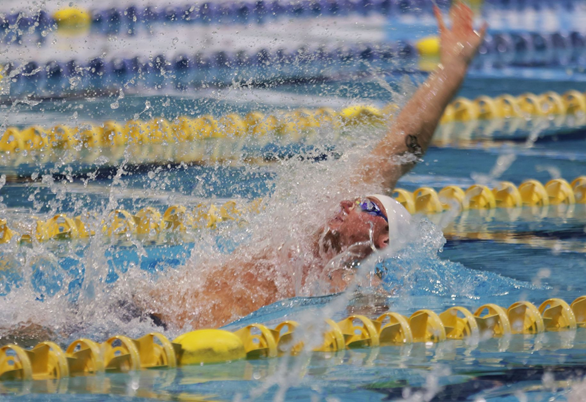
Seen Here: South African swimming sensation Pieter Coetze is setting his sights on another record-breaking performance in Astana, Kazakhstan, after rewriting the short-course 50m backstroke world record. With the 100m backstroke world record just 0.05 seconds beyond his latest winning time, the Tuks star is proving that greatness is built on precision, resilience and an unrelenting hunger to win. Photo Credit: Supplied
PRETORIA — South African swimming sensation Pieter Coetze could make history again this week, with the University of Pretoria (Tuks) star targeting a second world record in the space of seven days when the World Aquatics Swimming World Cup concludes in Astana, Kazakhstan.
The 22-year-old backstroke specialist heads into the final leg of the series brimming with confidence after breaking the men’s 50m backstroke short-course world record in Uzbekistan last Friday.
Now, attention turns to the 100m backstroke, where Coetze is closing in on the world-record mark of 48.16 seconds, set by Hungary’s Hubert Kós in Toronto in October 2025. Coetze won the event in Tashkent in 48.21 seconds, establishing a new African record and finishing just five-hundredths of a second outside the world mark.
The final leg of the World Aquatics Swimming World Cup takes place in Astana from 15 to 17 October, offering Coetze another opportunity to challenge the world’s best in the short-course pool.
For his coach, Rocco Meiring, another record-breaking performance is firmly within reach.
Meiring believes another record is possible
Meiring, Tuks swimming’s head coach, believes the intense competition among the world’s leading backstrokers is creating the conditions for extraordinary performances.
“Given how the swimmers are pushing each other in the backstroke events during the World Series (25m pool), it is certainly possible. It simply depends on how tired they are. I haven’t spoken to Pieter yet to hear how he is feeling,” says Meiring.
The coach believes the competition in men’s backstroke is so fierce that the winning performance at the 2028 Los Angeles Olympic Games could require a world-record-level swim.
“As I have said before, winning the gold medal in the backstroke at the 2028 Los Angeles Games will require a world record. I am absolutely convinced of this, because men’s backstroke is currently so competitive.”
For Coetze, the challenge is to maintain his exceptional form while managing fatigue after two demanding weekends of international racing.
To break Kós’s 48.16-second mark outright, Coetze will need to swim at least six-hundredths of a second faster than his current 48.21-second African record, reaching 48.15 or quicker.
A world record that made coaching worthwhile
Coetze’s record-breaking swim in the 50m backstroke was a defining moment not only for the swimmer, but also for Meiring, who admitted that the achievement felt almost unreal.
Last Friday in Tashkent, Coetze touched the wall in 22.09 seconds, lowering the previous short-course world record of 22.11 seconds. It was the kind of breakthrough that validates years of preparation, technical refinement and belief.
“When it happened last Friday, it felt unreal to me. Swimming a world record is obviously the ultimate achievement for any swimmer or coach because it sets a new world standard. What also encourages me is that Pieter’s times keep improving,” says Meiring.
The moment carried added emotional weight because the coach had endured a difficult week.
Severe storms in Pretoria caused power outages across the city, affecting the University of Pretoria’s sports campus and disrupting training conditions. Meiring said the situation became so challenging that he had to position cars around the swimming pool to provide enough light for athletes to finish their sessions.
Then came Coetze’s world record.
“What made Pieter’s record even more special was the fact that, as a coach, I was feeling completely down and out last week,” says Meiring.
“A storm in Pretoria caused power outages across the city. It affected us at the university sports campus too. The situation got so bad that I had to park cars around the pool to provide light so the swimmers could finish their training sessions. Then Pieter swam the world record, which made me realise all over again why I want to coach.”
It was a powerful reminder of the rewards that can emerge from perseverance, particularly when athletes and coaches must continue working through difficult circumstances.
Which backstroke distance suits Coetze best?
With Coetze now the world-record holder in the short-course 50m backstroke and a leading contender in the 100m and 200m events, the question is whether he should specialise in a particular distance as the Los Angeles Olympics approach.
Meiring believes the answer requires careful consideration.
Before the 2024 Paris Olympics, Coetze was ranked sixth in the world across all three backstroke distances — the 50m, 100m and 200m — demonstrating a rare combination of sprint speed and speed endurance.
“Few swimmers balance speed and speed endurance so well,” says Meiring.
He believes the 50m backstroke should not necessarily become Coetze’s priority, despite the latest world-record achievement. The event has not featured at the Olympic Games before but is due to make its debut at Los Angeles 2028.
Meiring points to the 50m freestyle as a useful comparison, arguing that the shortest events generally favour highly specialised sprinters.
“Swimmers can specialise in the 50m and 100m. You can also specialise in the 100m and 200m, but the training is completely different. I believe the 200m backstroke could become his signature event.”
That assessment places the focus firmly on long-term Olympic preparation rather than allowing one remarkable performance to dictate the direction of Coetze’s career.
Los Angeles remains the ultimate prize
Coetze’s near-miss in the long-course 100m backstroke at the 2026 Commonwealth Games in Glasgow has already demonstrated his potential to challenge the very best.
He won the final in 51.71 seconds, narrowly missing the world record of 51.60 seconds held by Italy’s Thomas Ceccon.
The performance reinforced the belief that Coetze possesses the speed and competitive temperament to challenge for the highest honours in international swimming.
Meiring says one of the swimmer’s greatest strengths is his ability to deliver under pressure.
“He has got big match temperament, which is something I certainly can’t coach swimmers to have. Pieter is also as tough as nails.”
Those qualities could prove decisive as the South African prepares for the final World Cup stop and, ultimately, his Olympic ambitions.
With the competition in Astana approaching, Coetze has the opportunity to build on his world-record breakthrough and further establish himself among the leading backstrokers in the world.
Another world record would be an extraordinary achievement. But for Coetze and Meiring, the bigger picture remains the pursuit of Olympic gold in 2028.
The world record is within reach, the rivalry is intense, and the Olympic dream is gathering momentum. In Astana, Pieter Coetze has another chance to show just how far South African swimming can go.
#PieterCoetze #TuksSwimming #WorldRecord #Swimming #TeamSouthAfrica #WorldAquatics #RoadToLA2028