Botswana-based artist brings an archaeology of domestic memory to the FNB Art Prize at Sandton Convention Centre
JOHANNESBURG — What if the walls, floors and objects of an ordinary home could remember us?
What if the marks left behind by a removed mirror, a missing electrical outlet cover, worn tiles, an ageing ironing board or a battered iron could tell a story about the people who lived around them?
For Botswana-based visual artist Kelebogile Marope, these seemingly insignificant traces are far from meaningless. They are fragments of memory, records of labour and evidence of time—and they form the conceptual foundation of Archaeologies of Use, her proposed series of sculpted canvas works submitted for consideration for the FNB Art Prize.
Marope’s involvement in the FNB Art Prize at the Sandton Convention Centre places an unconventional question at the centre of the contemporary art conversation: what happens when we stop looking at the objects of everyday life and start looking at the traces they leave behind?
It is a question that runs through Marope’s practice and gives Archaeologies of Use its quiet but compelling power.
Rather than celebrating domestic objects as treasured artefacts, Marope looks at what remains when those objects disappear.
The result is a body of work positioned somewhere between painting, sculpture and architecture—works that transform the traditionally flat canvas into physical terrain and invite viewers to reconsider the spaces they inhabit.
An archaeology of the ordinary
Marope’s artistic practice has long been concerned with ordinary objects and domestic surfaces.
Her interest lies not necessarily in the objects themselves, but in the evidence of repeated human interaction with them.
A wall where tiles once existed.
A rectangular patch where a mirror hung.
The outline left by an electrical outlet cover.
The depression around a bathtub drain.
The softened surface of an ironing board.
The worn soleplate of an iron.
These are the details that most people overlook.
For Marope, however, they become an archive.
Archaeologies of Use takes these overlooked remnants and elevates them into sculptural propositions, asking viewers to consider how everyday routines become physically embedded in the environments around us.
The exhibition’s title is therefore particularly apt. This is archaeology without ancient ruins or monumental relics. It is an archaeology of contemporary domestic life—one built from repetition, touch, maintenance, labour and absence.
The home becomes an archive, and its surfaces become evidence.
Painting that refuses to remain flat
At the heart of Marope’s approach is sculpted canvas, a process that allows her to collapse the traditional distinction between painting and sculpture.
Her canvases are carved, shaped and constructed to create relief surfaces in which light and shadow become part of the work.
The physicality is crucial.
These are not simply paintings depicting damaged walls or worn household objects. The surfaces themselves become sculptural records, allowing the viewer to encounter the work as an object.
That approach creates a compelling tension between image and material.
The viewer does not simply look at a representation of a surface. They encounter a surface that has been transformed into an object of contemplation.
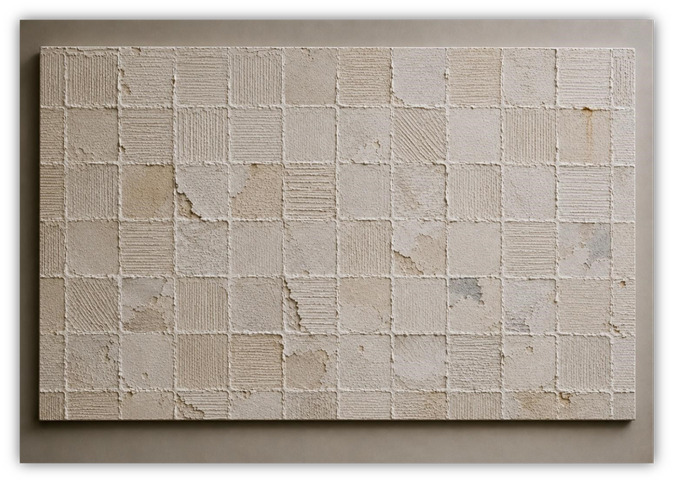
This becomes particularly evident in works such as Residual Memory, where the removal of ceramic bathroom tiles is translated into a sculptural canvas preserving the adhesive, grout lines and impressions left behind.
The tiles are gone.
But their absence remains visible.
And it is precisely this absence that becomes the subject.
When absence becomes evidence
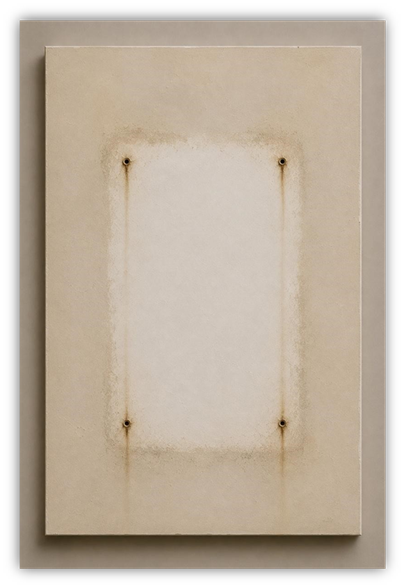
In Displaced, Marope turns her attention to the space once occupied by a domestic mirror.
A lighter rectangular field, fixing points and accumulated dust become clues to an object that is no longer there.
The mirror itself has disappeared, but the wall remembers.
This recurring idea of absence is one of the most powerful dimensions of the series.
Marope suggests that objects do not simply occupy domestic spaces; they alter them. Their presence leaves physical and visual consequences, and their removal does not necessarily erase those histories.
The architecture retains the evidence.
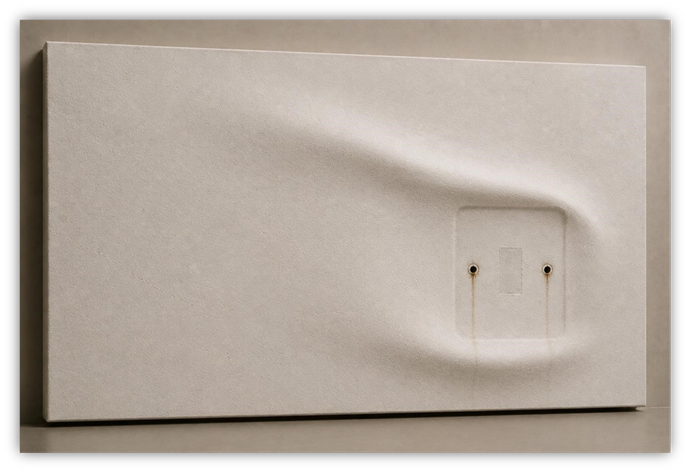
In Removal, the artist focuses on the traces left after an electrical outlet cover has been detached—screw holes, discolouration and protected outlines becoming a small archaeological site.
What was once functional is transformed into evidence.
The mundane becomes monumental.
The body leaves a mark
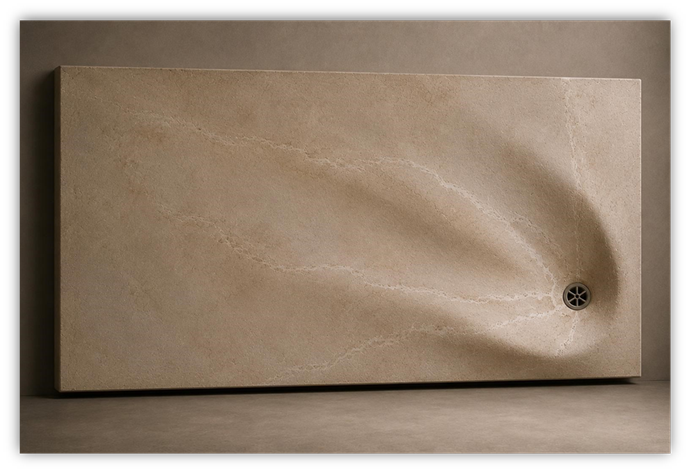
Perhaps the most bodily work in the series is Somatic Trace, which considers the floor of a bathtub and the space surrounding its drain.
Rather than depicting the bathtub as an object, Marope explores the surface shaped by repeated bodily presence.
Water, gravity, movement and routine gradually alter the material environment.
The drain becomes an anchor, while the surrounding relief evokes the invisible choreography of countless acts of washing.
Here, the domestic surface becomes almost topographical.
The body is absent, yet its presence can be felt through the landscape it has helped create.
It is an important shift in perspective: Marope is not interested in documenting domestic life literally, but in revealing the physical consequences of living.
Labour written into surfaces
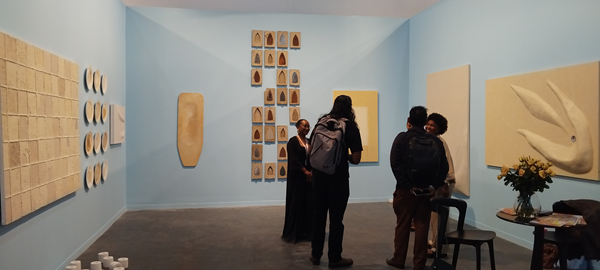
The theme of repetition becomes particularly poignant in After Time, inspired by the worn surface of an ironing board.
Years of domestic labour become visible through softened contours, depressions and subtle discolouration.
The ironing board itself is not reproduced.
Instead, Marope extracts its material history.
In doing so, she raises questions about the nature of labour and whose work becomes visible—or remains invisible—within domestic spaces.
The surface becomes a quiet monument to repetition.
Every movement has left something behind.
Every act of labour has altered the material world.
Everyday life, Marope proposes, is not as immaterial as it appears.
Excavating the history of use
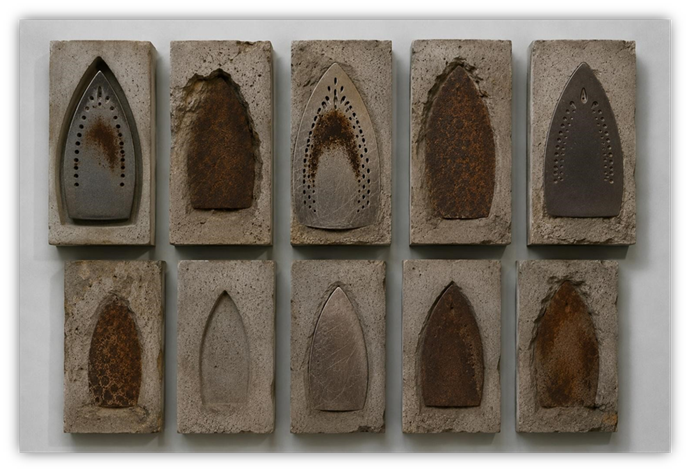
The sculptural installation Excavation of Use extends this thinking beyond canvas.
Reclaimed cast-iron soleplates are partially embedded within concrete blocks, creating the impression of archaeological artefacts unearthed from the ground.
The juxtaposition is deliberate.
Concrete is conventionally associated with construction, permanence and infrastructure. Here, however, it becomes a medium of preservation.
The exposed iron soleplates reveal scratches, abrasions and polished areas created through years of ironing.
Their deterioration is not treated as damage.
It becomes evidence.
The objects carry the physical record of domestic labour long after their functional lives have ended.
In this sense, Excavation of Use perhaps offers the clearest expression of Marope’s central proposition: the ordinary can become an artefact when we learn how to read it.
A distinctive voice from Botswana
Marope’s participation in the FNB Art Prize also brings a Botswana-based artistic voice into a major South African contemporary art platform.
Holding a Master of Fine Arts in Sculpture, her practice spans painting, sculpture and installation, consistently exploring the relationship between material, memory and everyday life.
Her work is particularly interested in the overlooked—the objects, surfaces and gestures that rarely command attention but collectively form the texture of human existence.
That sensibility gives her work an understated quality.
There is no need for spectacle.
The power lies in looking closely.
Marope asks audiences to slow down and recognise that a damaged surface, a worn object or an empty architectural space can contain a history every bit as compelling as a formally preserved artefact.
Why the FNB Art Prize matters
The FNB Art Prize has become an important platform for recognising and advancing contemporary African artistic voices.
For an artist such as Marope, participation offers an opportunity to place a materially driven and conceptually nuanced practice before an audience of collectors, curators, artists, cultural practitioners and art enthusiasts.
Her work also speaks directly to the broader evolution of contemporary African art, where artists increasingly interrogate the relationship between personal experience, material culture, history and identity.
At the Sandton Convention Centre, Archaeologies of Use becomes more than an exhibition proposal.
It becomes an invitation to reconsider what qualifies as a record of human life.
Marope’s answer is both simple and profound: perhaps the most important records are not the objects we deliberately preserve, but the surfaces we leave behind.
The memory of what remains
There is something deeply human in Marope’s fascination with residue.
We tend to remember significant objects—the photographs, heirlooms, furniture and possessions that become repositories of personal history.
But homes are filled with less obvious evidence.
The indentation of a chair.
The worn path across a floor.
The faded outline of a picture frame.
The scratches on a working surface.
The marks left by hands, feet, water, heat and repetition.
These traces rarely receive our attention.
Marope gives them a voice.
Through Archaeologies of Use, she transforms the residue of ordinary life into sculptural language, challenging viewers to reconsider the relationship between object and absence, function and memory, painting and sculpture.
Her work ultimately suggests that a home is never simply a structure.
It is a living archive—and even after the objects are gone, the surfaces remember.