Johannesburg, 1 October 2026 — Rising fuel costs are increasingly influencing how South Africans shop for vehicles, with motorists placing greater emphasis on fuel efficiency, running costs and affordable alternatives to conventional petrol-powered cars.
New consumer data from Cars.co.za indicates that fuel-price volatility is not necessarily causing prospective buyers to abandon vehicle purchases. Instead, it is changing the criteria they use to determine which vehicles offer the best value over the longer term.
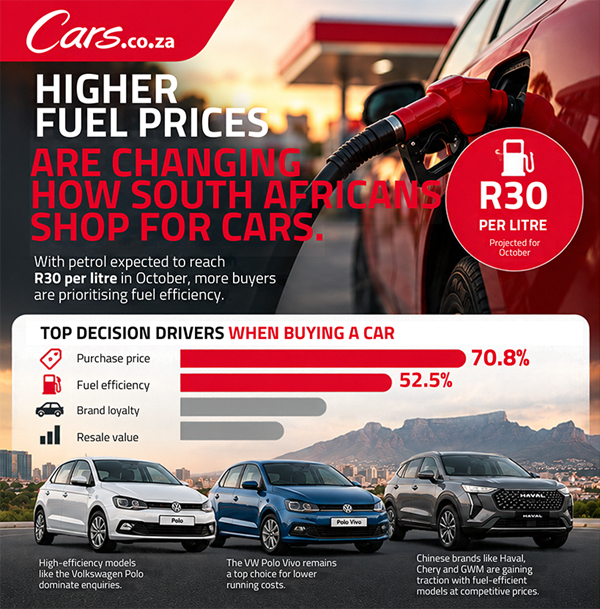
According to the Cars.co.za Industry Report 2026, fuel efficiency is now cited by 52.5% of surveyed active car buyers as a key vehicle-selection factor, second only to purchase price at 70.8%.
The findings point to a growing focus on total cost of ownership, as consumers consider not only the price of a vehicle but also how much it will cost to operate, maintain and fuel over its lifespan.
Smaller engines gain appeal
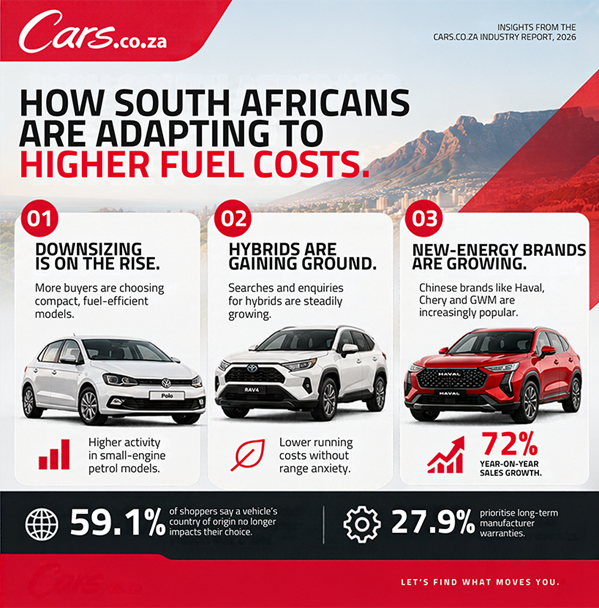
One of the clearest trends emerging from the platform is growing interest in compact, fuel-efficient vehicles.
Models such as the Volkswagen Polo and Polo Vivo continue to generate significant enquiry volumes, with buyers increasingly weighing fuel consumption alongside traditional considerations such as brand, specifications and resale value.
For households under financial pressure, the attraction is straightforward: a vehicle that consumes less fuel can reduce one of the most persistent monthly costs associated with private transport.
Hybrids emerge as a middle ground
While battery-electric vehicles continue to expand their presence in South Africa, adoption remains influenced by factors including purchase prices and the availability of public charging infrastructure.
Hybrid vehicles are consequently emerging as an alternative for motorists looking to reduce fuel consumption without moving completely away from internal-combustion technology.
Cars.co.za reports steady quarter-on-quarter growth in search and enquiry activity for petrol-electric hybrids, suggesting that consumers are increasingly considering electrified drivetrains as part of their vehicle-shopping process.
Hybrids can offer motorists the potential for improved fuel economy while retaining the convenience of a conventional refuelling network — a combination that may appeal to buyers who remain cautious about making the transition to a fully electric vehicle.
Chinese brands expand the value proposition
The changing market is also creating opportunities for Chinese automotive manufacturers, which have expanded their presence in South Africa with competitively priced vehicles and increasing numbers of hybrid and new-energy offerings.
Cars.co.za says sales of Chinese automotive brands have increased 72% year-on-year, while brands including Haval, Chery and GWM are increasingly competing in segments traditionally dominated by established manufacturers.
The platform’s research also found that 59.1% of surveyed shoppers say a vehicle’s country of origin no longer influences their choice, indicating that considerations such as pricing, specifications, efficiency and perceived value are increasingly shaping purchasing decisions.
The total-cost calculation
Alan Quinn, Chief Innovation and Product Officer at Cars.co.za, says motorists are increasingly calculating the broader financial implications of owning a vehicle.
“When petrol moves closer to R30 a litre, the monthly cost of running a vehicle rapidly rivals the monthly finance payment itself,” Quinn said.
According to Quinn, consumers are increasingly comparing cost per kilometre, fuel consumption and service-plan coverage alongside the upfront purchase price.
He also cautioned against viewing the shift purely as an electric-vehicle transition.
“While full electric vehicles are growing, the immediate relief for most South Africans comes from pragmatic alternatives, whether that’s switching to a self-charging hybrid, choosing a modern 1.0-litre turbocharged petrol engine or looking at competitive value propositions from new market entrants,” he said.
Finance remains central to affordability
The pressure on household budgets is also expected to influence how motorists finance their next vehicles.
Cars.co.za reports that 53% of South African consumers are actively cutting back on discretionary spending, making monthly affordability an increasingly important consideration.
Finance structures, balloon payments and ongoing operating expenses are therefore likely to play a greater role in purchasing decisions as consumers attempt to balance vehicle ownership with other household commitments.
At the same time, longer manufacturer warranties could help build confidence in newer technologies. According to the platform, 27.9% of shoppers prioritise long-term manufacturer warranty coverage.
Digital research meets real-world testing
The way motorists research vehicles is also evolving.
Cars.co.za’s data shows that 35.2% of consumers rely on video and written reviews, while 35.3% ultimately place importance on test drives before making a purchase.
That combination reflects a broader shift towards digitally informed but practically verified buying decisions. Online research allows consumers to compare specifications, prices and ownership considerations, while test drives provide an opportunity to assess factors such as driving characteristics and real-world fuel consumption.
As fuel prices remain a significant household expense, the South African vehicle market appears increasingly focused on a simple calculation: how much will this car cost me to own and operate, not merely how much does it cost to buy?
For motorists, that shift could accelerate demand for smaller engines, hybrids and competitively priced new-energy vehicles — reshaping the country’s automotive landscape as consumers search for greater efficiency without compromising everyday mobility.