

A year after winning the FNB Art Prize, the artist is preparing for a solo exhibition that illustrates what sustained investment in creative talent can unlock
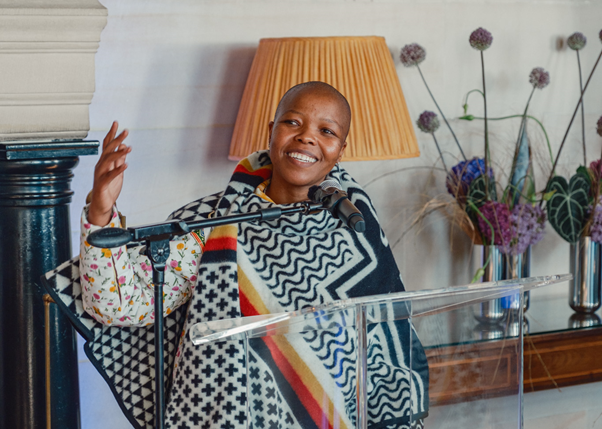
Seen Here: A year after winning the 2025 FNB Art Prize, Thato Toeba is taking the next bold step in their artistic journey — bringing a new body of work to the Johannesburg Art Gallery (JAG) as part of their FNB Art Joburg solo exhibition. Photo Credit: Supplied
JOHANNESBURG, 31 August 2026 — For Thato Toeba, the journey from winning the 2025 FNB Art Prize to presenting a solo exhibition at the Johannesburg Art Gallery (JAG) has been about more than producing a new body of work.
It has been about what becomes possible when artistic recognition is followed by meaningful opportunity, resources and time.
With only days remaining before their FNB Art Joburg solo exhibition opens at JAG on Sunday, 6 September 2026, Toeba finds themselves negotiating the practical demands of mounting a major exhibition alongside deeper questions about architecture, history, identity and the role of the artist.
The result offers a compelling case study in the value of investing in creative talent: the impact of an arts prize is not necessarily measured by the moment an artist’s name is announced, but by what that recognition enables them to do afterwards.
“There is something very generous about being told, essentially, you have this opportunity, now make something,” says Toeba. “It creates a different kind of pressure, but also a different kind of freedom.”
That distinction sits at the heart of the FNB Art Prize’s philosophy.
Rather than treating an award as the conclusion of an artist’s journey, the prize creates a platform for further development, including the opportunity to realise a solo exhibition at one of Johannesburg’s most significant cultural institutions.
For Toeba, that opportunity has resulted in a year of experimentation and expansion.
From collage to constructing new realities
Toeba’s artistic language has its origins in an instinct that began during childhood.
As children, Toeba and their twin would cut images from magazines and assemble them in exercise books, creating alternative worlds from fragments of existing ones.
Years later, that childhood practice evolved into a sophisticated engagement with collage, photography and archival material — and with the ways in which history and authority are constructed.
Toeba’s background in law has also influenced this approach.
The artist is interested in the mechanisms through which systems establish legitimacy and present particular versions of reality as objective or authoritative. Within the artistic process, however, images can be removed from their original context, repositioned and placed into new relationships.
“I could take an image, cut it apart, put it next to something else and suddenly the authority of the original image became unstable,” Toeba explains.
“I am interested in how realities are constructed, who constructs them, and what happens when you start moving the pieces around.”
It is an approach that makes the archive not simply a repository of history, but a contested space.
Images carry information, but they also carry power. What is preserved, what is discarded, who is represented and who is absent can influence the stories societies tell about themselves.
By the time Toeba won the FNB Art Prize in 2025, these strands — archive, photography, collage, history, politics and play — had begun converging into a more expansive artistic practice.
“There was the archive, there was photography, there was collage, there was history and politics, but there was also play,” says Toeba. “I think it represented a moment of clarity.”

The business case for backing artists beyond the award
Toeba’s experience demonstrates a broader principle relevant to the creative economy: talent development requires more than recognition.
An award can create visibility, but sustained opportunity creates the conditions for experimentation.
For financial institutions and corporations investing in the arts, this distinction is increasingly significant. Cultural sponsorship can move beyond traditional brand exposure when it creates tangible platforms through which artists can develop their practices, reach new audiences and contribute to the cultural economy.
Linda Kachingwe-Sisya, Chief Marketing Officer at FNB, says this longer-term impact is central to the organisation’s approach to the FNB Art Prize.
“The real measure of any art platform is not the moment of recognition itself, but what that recognition unlocks,” says Kachingwe-Sisya.
“Our ambition with the FNB Art Prize has always been to create opportunities that extend beyond the award, empowering artists to grow their craft, explore new creative frontiers and strengthen their presence in the contemporary art landscape.”
Toeba’s progression from prize recipient to solo exhibitor, she says, demonstrates how sustained support can help transform potential into lasting artistic impact.
The distinction is important in an industry where artists often face significant barriers to production, exhibition and access to institutional platforms.
“An artist can have a very ambitious idea and still not have the material conditions to make it,” Toeba says.
“So when an institution says, here is a space, here is some support, take this seriously and make the work, that can change the trajectory of a practice.”
When architecture becomes part of the investment
The JAG exhibition has also challenged Toeba to think beyond individual artworks and consider the exhibition as an integrated experience.
The Johannesburg Art Gallery is not a neutral container.
Its monumental architecture, history and physical presence have become part of the artist’s thinking about how audiences encounter the work.
“JAG is such a particular building. It has this monumental quality, and I think that has made me think differently about what an exhibition can be,” says Toeba.
“The architecture has its own history, its own authority, its own ghosts.”
Initially, Toeba approached the exhibition as a relatively straightforward proposition: create the work and install it inside the gallery.
Time spent in the building changed that understanding.
“I had this idea that I would make the work and then install it in JAG,” they say. “But the more time I spent there, the more ridiculous that idea seemed. The building is too present.”
That realisation has transformed the exhibition from a collection of objects into a dialogue between artwork, architecture and city.
“The exhibition has become less about putting objects into a room and more about figuring out what happens when the work, the building and the city start speaking to each other.”
It is a particularly Johannesburg conversation.
Toeba describes the city through movement, migration, extraction, aspiration, violence and reinvention — forces that have shaped both its physical landscape and its social history.
The exhibition therefore becomes an exploration of how historical narratives remain embedded in contemporary spaces.
“These things are historical, but they are also completely present,” Toeba says.
Recognition as a platform, not a destination
The commercial and institutional value of programmes such as the FNB Art Prize lies partly in their ability to create a bridge between emerging or developing artists and larger cultural ecosystems.
For artists, that ecosystem can include galleries, museums, collectors, curators, corporate patrons, audiences and international networks.
The JAG exhibition gives Toeba access to one of the country’s most important public art spaces while allowing the artist to test ideas on a larger scale.
It also illustrates the potential multiplier effect of cultural investment.
A prize creates recognition.
Recognition creates opportunity.
Opportunity creates new work.
New work creates audiences, conversations and further professional possibilities.
For the artist, the process can therefore become an important form of creative and professional capital.
“There is a point where you have to stop imagining the exhibition and actually let it become something,” says Toeba. “That is probably the hardest part.”
The value of not having all the answers
Despite the scale and significance of the occasion, Toeba is resistant to framing the exhibition as an arrival point.
Instead, they want the work to remain open-ended.
“I would rather people encounter something and have a feeling that there is more to it than what they can immediately understand,” they say.
“I hope they argue. Not necessarily with me, but with the work, with each other, maybe even with themselves.”
That approach is consistent with an artistic practice concerned with questioning authority and disrupting fixed narratives.
The objective is not necessarily to provide another definitive interpretation of history, but to create conditions in which audiences question the interpretations they have inherited.
Toeba hopes to remember the JAG exhibition not as the moment their journey reached its destination, but as the point at which its possibilities became larger.
“I would rather it be the exhibition where I took a risk and opened something up,” they say.
Because, for Toeba, the most productive artwork may be one that refuses to settle.
“I want it to keep making problems for me.”
A model for creative-sector investment
As Toeba prepares to open the exhibition, their journey illustrates a potentially important lesson for South Africa’s creative economy: investment in artists delivers its greatest value when it creates the conditions for artists to keep developing.
The FNB Art Prize provided the initial recognition. The subsequent opportunity to work towards a solo exhibition at JAG has provided the space, challenge and resources to push the practice further.
For Toeba, that has meant moving from the manipulation of individual images towards questions of space, architecture and the relationship between artwork and city.
For the broader arts ecosystem, it demonstrates how corporate support can contribute to the development of creative careers when it is structured around meaningful artistic opportunities rather than a once-off moment of visibility.
And for audiences, it offers an invitation to enter a conversation that is deliberately unfinished.
Thato Toeba’s FNB Art Joburg solo exhibition opens at the Johannesburg Art Gallery on Sunday, 6 September 2026.


