Joburg Theatre celebrates one of South Africa’s defining musical voices through a three-day theatrical concert featuring Nathi, Moneoa, Amanda Black and Nokukhanya Dlamini

JOHANNESBURG — Some songs entertain us. Others become part of who we are.
For generations of South Africans, the music of Caiphus Semenya has occupied that rare space where melody becomes memory, songwriting becomes storytelling and an artist’s work becomes woven into the cultural fabric of a nation.
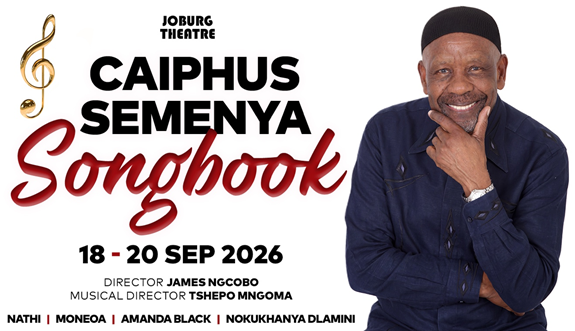
Now, Joburg Theatre is preparing to celebrate that extraordinary legacy with Caiphus Semenya Songbook, a three-day live production running from 18 to 20 September 2026, bringing together some of South Africa’s most distinctive contemporary voices to revisit the work of one of the country’s most celebrated composers, musicians and songwriters.
The production promises to be more than a retrospective.
It is a conversation between generations.
At its heart is the enduring repertoire of Semenya—a body of work shaped by love, identity, home, resilience and the complexities of the South African experience. Through new interpretations, the production will demonstrate how great songs can transcend the circumstances in which they were created to acquire new meaning for successive generations.
A legacy carried through song
Semenya’s contribution to South African music extends far beyond individual compositions.
His career represents an important chapter in the country’s musical history, with his songwriting and collaborations helping shape a distinctive South African sound that has travelled across borders and generations.
His music has endured because it speaks to experiences that remain deeply human.
Love. Belonging. Loss. Hope. Home.
These themes allow his work to continually find new listeners, while his compositions provide younger performers with an extraordinary musical vocabulary through which to explore their own artistry.
That makes Caiphus Semenya Songbook particularly significant.
Rather than attempting to reproduce the past, the production allows contemporary artists to encounter Semenya’s repertoire through their own musical identities.
Four voices, one extraordinary songbook
The production features Nathi, Moneoa, Amanda Black and Nokukhanya Dlamini, bringing four distinctive contemporary voices to Semenya’s repertoire.
Each artist brings a different perspective and musical sensibility, creating an opportunity for familiar songs to be heard afresh.
The result is intended to be a celebration rather than an imitation—a recognition that the most powerful musical legacies remain alive precisely because artists continue to reinterpret them.
For audiences who grew up with Semenya’s music, the production offers a chance to reconnect with songs embedded in their memories.
For younger audiences, it provides an introduction to a remarkable body of work through artists whose voices belong to their own generation.
That meeting point between memory and discovery is central to the production’s appeal.
James Ngcobo brings theatre into the songbook
Adding another layer to the production is its director, acclaimed theatre-maker James Ngcobo, Artistic Director of Joburg City Theatres.
Ngcobo’s involvement ensures that Caiphus Semenya Songbook is conceived not simply as a concert, but as a theatrical experience.
His approach places the music within a broader framework of storytelling, memory and cultural history, allowing the songs to communicate not only through sound but through the emotional and historical contexts surrounding them.
It is an important distinction.
A songbook can preserve music.
Theatre can give that music a world in which to live.
Tshepo Mngoma leads the musical journey
Musical direction comes from respected musician and composer Tshepo Mngoma, who will guide the production’s interpretation of Semenya’s repertoire.
His role is central to finding the balance between honouring the musical character of the original compositions and allowing the contemporary performers the freedom to bring their own artistry to the material.
Together, Ngcobo and Mngoma create the framework for a production that looks simultaneously backwards and forwards—honouring Semenya’s contribution while demonstrating how his music can continue to evolve.
More than nostalgia
While Caiphus Semenya Songbook will undoubtedly evoke nostalgia for audiences familiar with the music, its ambitions reach beyond remembrance.
The production asks a larger question: How does a musical legacy remain alive?
The answer is not simply through archives, recordings or historical recognition.
It survives when songs are sung.
It survives when younger musicians discover them.
It survives when audiences introduce them to their children.
And it survives when contemporary artists find something of themselves in the work of those who came before them.
In that sense, the production is an act of cultural preservation—but one that refuses to keep heritage frozen in time.
A bridge between generations
There is a particular significance in presenting Semenya’s work through artists such as Nathi, Moneoa, Amanda Black and Nokukhanya Dlamini.
South African music is constantly evolving, with each generation adding new influences, sounds and perspectives.
Yet musical progress does not require cultural amnesia.
The Caiphus Semenya Songbook demonstrates that contemporary music can engage meaningfully with the country’s musical heritage while creating space for fresh interpretation.
The stage at Joburg Theatre therefore becomes a meeting place between generations: between one of South Africa’s great musical architects and artists carrying the country’s musical story into the future.
A celebration of a national treasure
For three days, Joburg Theatre will become a space for audiences to listen, remember and rediscover.
Caiphus Semenya Songbook celebrates an artist whose music has survived the passing of time because it continues to speak.
It celebrates the musicians who interpret his work today.
And it celebrates audiences who understand that some songs are more than songs—they are markers of where we have been, reflections of who we are and bridges towards where we are going.
The production is ultimately a reminder that cultural legacy is not something that belongs exclusively to the past.
It is something we inherit, reinterpret and carry forward.
And when the lights go down at Joburg Theatre, Caiphus Semenya’s songbook will continue to do what it has always done best: tell the story of South Africa, one unforgettable song at a time.