Banking group raises returns, strengthens digital franchise and maintains confidence in Africa’s long-term growth prospects
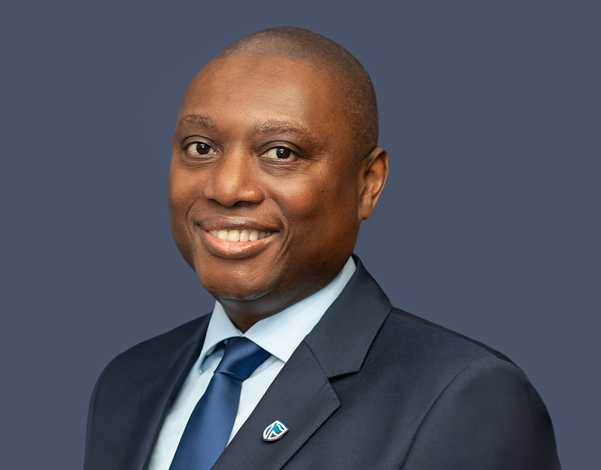
Seen Here: Sim Tshabalala, Standard Bank Group CEO, says the banking group’s record first-half performance reflects the strength and resilience of its diversified African franchise, with headline earnings rising 10% to R26.1 billion and return on equity improving to 19.8% for the six months ended 30 June 2026. Photo Credit: Supplied
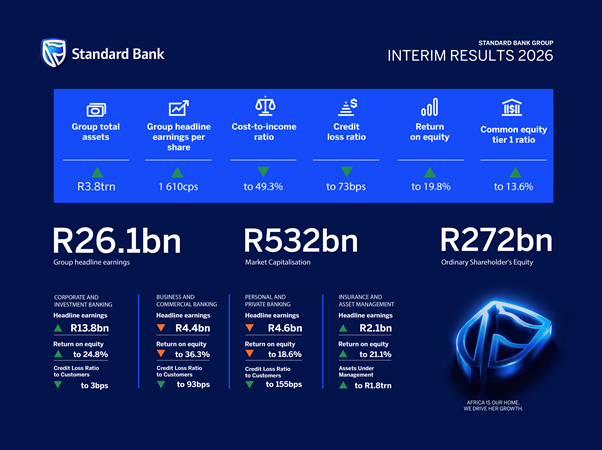
Johannesburg, 13 August 2026 — Standard Bank Group has delivered a record first-half performance, with headline earnings rising 10% to R26.1 billion for the six months ended 30 June 2026, as stronger client activity, disciplined cost management and lower credit impairments supported growth across the diversified financial services group.
The performance lifted the group’s return on equity (ROE) to 19.8%, up from 19.1% in the prior-year period and comfortably within Standard Bank’s 2028 target range of 18% to 22%.
The results underscore the resilience of Standard Bank’s Africa-focused business model at a time when economic conditions, regulatory environments and technology are rapidly evolving across the continent.
Headline earnings per share increased by 10% to 1 610 cents, while the interim dividend also rose 10% to 902 cents per share.
The group’s cost-to-income ratio improved marginally to 49.3%, compared with 49.5% in the first half of 2025, while the credit loss ratio improved significantly to 73 basis points, from 93 basis points a year earlier.
Standard Bank’s common equity tier 1 (CET1) ratio also strengthened to 13.6%, compared with 13.2% at 30 June 2025.
Africa remains central to the growth story
A defining feature of the results was the continued contribution from Standard Bank’s operations outside South Africa.
The bank’s Africa Regions business contributed R10.4 billion, or 40% of Group headline earnings, supported by strong performances in markets including Angola, Ghana, Kenya, Mauritius, Mozambique, Nigeria, Uganda and Zambia.
South Africa remained the group’s largest contributor, generating R13.4 billion, or 51% of Group headline earnings.
Offshore businesses contributed a further R1.3 billion, while Standard Bank’s 40% stake in ICBC Standard Bank Plc contributed R1.0 billion, up 22%.
Sim Tshabalala, Standard Bank Group CEO, said the results demonstrate the strength of the group’s diversified franchise.
“Standard Bank delivered a strong performance in the first half of 2026,” said Tshabalala. “Strong client-led growth in non-interest revenue, together with disciplined cost and credit management, supported growth in headline earnings and our highest return on equity under the Basel III capital framework.”
He highlighted the growing importance of Africa to the group’s performance, noting that Africa Regions now account for 40% of headline earnings.
Payments franchise gains momentum
Standard Bank’s payments business was another important growth engine during the period.
Domestic electronic payment values increased by 11%, while cross-border electronic payment values grew by 7%.
The group maintained leading market shares in cross-border payments, accounting for approximately 30% in South Africa and 19% across its Africa Regions.
These capabilities reinforce Standard Bank’s position as Africa’s largest transactional banking franchise by payment value, while also supporting deposit mobilisation and transaction-driven revenue growth.
The bank’s digital strategy is similarly gaining traction.
In South Africa, targeted initiatives to grow digital retail transactional clients resulted in a 9% increase in digital clients, with 69% of transactional clients now using digital channels. Digital transactional volumes increased by 17%.
The figures point to a broader shift in customer behaviour and Standard Bank’s efforts to deepen its digital relationship with clients.
Strong performance across key businesses
The group’s business units continued to deliver healthy returns, although performance varied across segments.
Corporate & Investment Banking was a standout performer, increasing headline earnings by 15% to R13.825 billion and achieving an ROE of 24.8%.
Insurance & Asset Management also recorded 15% growth in headline earnings, reaching R2.078 billion, with an ROE of 21.1%.
Business & Commercial Banking delivered an ROE of 36.3%, despite headline earnings declining 2% to R4.448 billion.
Personal & Private Banking generated headline earnings of R4.6 billion, down 1%, while delivering an ROE of 18.6%.
Overall, the Standard Bank franchise generated headline earnings of R25.081 billion, up 9%, while the group’s 40% stake in ICBC Standard Bank Plc contributed R1.019 billion.
Balance sheet remains resilient
Standard Bank’s balance sheet continued to expand, with total assets under administration and management increasing by 14% to R1.8 trillion.
The improvement in the credit loss ratio to 73 basis points also points to a more favourable credit environment and reflects what the group described as sound risk management.
At the same time, income growth continued to outpace cost growth, producing positive jaws of 44 basis points.
This combination of revenue growth, cost discipline and controlled credit losses helped underpin the group’s improved profitability.
Financing Africa’s sustainable growth
Beyond its financial performance, Standard Bank continues to position itself as a key financier of Africa’s transition towards more sustainable economic growth.
Since 2022, the group has cumulatively mobilised more than R328 billion in sustainable finance for clients, against a target of R450 billion by 2028.
During the first half of 2026 alone, it mobilised R50.6 billion.
The initiative forms part of the bank’s broader strategy of supporting clients as economies across the continent respond to changing energy, infrastructure, climate and development requirements.
Confidence in South Africa and the continent
Tshabalala said the group remains encouraged by the outlook for South Africa but believes the country needs to deepen its economic integration with the wider continent to fully participate in Africa’s growth opportunity.
“We are particularly encouraged by the resilient outlook for South Africa,” he said. “Sustaining that momentum will require the country to deepen its economic integration with the rest of the continent and fully participate in Africa’s growth opportunity.”
The comments reflect Standard Bank’s positioning as an Africa-focused financial institution with operations spanning multiple of the continent’s major economies.
According to the group, Africa is expected to grow faster than most other regions, creating significant opportunities despite intensifying competition, evolving regulation and rapid technological change.
2026 outlook remains unchanged
Despite the strong first-half performance, Standard Bank has maintained its full-year guidance.
For the 12 months ending 31 December 2026, the group expects:
- Banking revenue growth: Mid-to-high single digits.
- Cost-to-income ratio: A slight decline, supported by its “save to invest” approach.
- Credit loss ratio: Slightly higher than 2025, but within the lower half of its 70–100 basis point through-the-cycle target range.
- ROE: Higher than the prior year.
The group says its strategy will continue to focus on disciplined capital allocation, targeted investment in technology and capabilities, and sustainable client-led growth.
“Our 2028 strategy is anchored in a clear ambition: to compete and win in our chosen markets and client segments,” Tshabalala said.
“We are disciplined in how we allocate capital, selective about the opportunities we pursue, and relentless in our focus on execution.”
With record earnings, stronger returns and an increasingly important contribution from its African operations, Standard Bank enters the second half of 2026 from a position of considerable financial strength.
The challenge now is to sustain that momentum while navigating the economic, technological and competitive forces reshaping Africa’s financial services landscape.