

Utility, value and attainable innovation emerge as defining forces, even as select premium nameplates retain their allure.
By: Lonwabo Mtyeku | Photo Credit: Supplied

Johannesburg – Automotive Feature
South Africa’s automotive retail market is in the midst of a notable recalibration, as new entrants and shifting consumer priorities redefine what success looks like on showroom floors and online platforms. The latest demand data from Cars.co.za reveals a market that is no longer driven solely by legacy prestige, but by a more nuanced balance between affordability, practicality and lifestyle-oriented utility.
The data, based on lead share for vehicles younger than five years with fewer than 200,000km, points to a maturing market responding to sustained financial pressure on consumers while still preserving appetite for select premium offerings.
A Market in Rebalance
At the heart of this shift is value — a principle now shaping decisions across both volume and premium segments. The movement of certain luxury brands out of the upper rankings does not signal collapsing demand, but rather the impact of a rapidly expanding pool of attainable brands competing for attention. As more mass-market and emerging manufacturers enter the fray, the threshold for inclusion in the top tiers has risen sharply.
This has resulted in a redistribution of demand rather than a contraction, with consumers increasingly weighing cost of ownership, versatility and perceived reliability alongside brand aspiration.
Top 50 Brands: New Energy Meets Familiar Strength
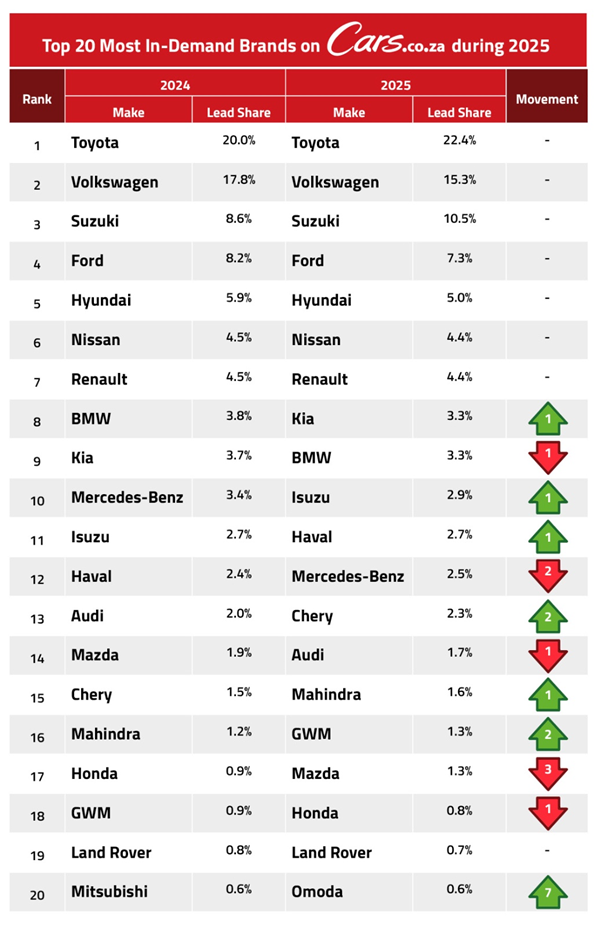
While the top seven brands have held their ground, the broader Top 50 paints a picture of diversification and momentum:
- Attainable brands on the rise: Jetour delivered the most dramatic leap, climbing from 44th to 22nd position. Chery (13th) and Omoda (20th) continued their upward trajectory, while MG (38th) and BYD (40th) have now firmly established themselves within the Top 50.
- Resilient incumbents: Toyota and Suzuki extended their lead share, reinforcing their reputations for durability, value and wide-ranging product portfolios that resonate with cost-conscious buyers.
- Luxury displacement, not decline: The absence of ultra-niche marques such as Ferrari, Lamborghini and McLaren reflects ranking pressure from new entrants rather than a collapse in demand for high-end performance vehicles.
Premium Demand Finds a New Shape
Despite the growth of the budget-conscious segment, South African buyers continue to demonstrate strong loyalty to premium vehicles — particularly those offering utility and lifestyle appeal.
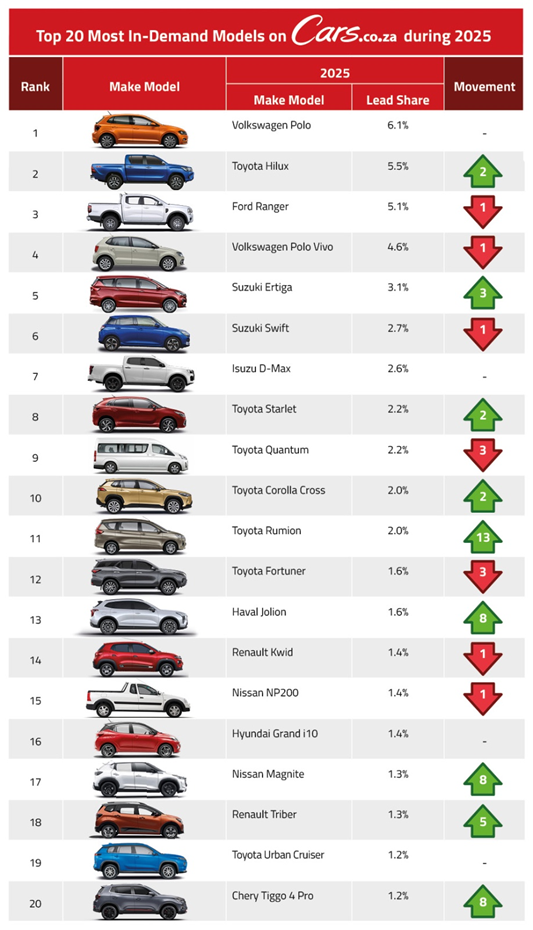
- SUVs and bakkies dominate: The Toyota Land Cruiser Prado surged 24 places, while the Land Cruiser 79 climbed 19 positions, underscoring the enduring appeal of rugged luxury. The Land Rover Defender remains another standout, blending heritage with modern capability.
- The mid-size battleground: Chinese manufacturers are making decisive inroads in one of the most competitive segments. Chery’s Tiggo 8 Pro recorded the biggest single-year gain in the Top 100, jumping 33 positions and highlighting how traditional brands are losing ground in this category.
- Bakkie supremacy continues: The Toyota Hilux reclaimed its crown as South Africa’s most sought-after bakkie. Meanwhile, the GWM P-Series rose 16 places to 24th, reinforcing its credibility as a serious alternative in a fiercely contested segment.
Value Takes Centre Stage
Perhaps the clearest signal of changing buyer priorities lies at the volume end of the market. The Suzuki Ertiga (5th) and Toyota Rumion (11th) — effectively mechanical twins — now command a combined lead share comparable to that of the third-placed Ford Ranger. This reflects a decisive shift towards practical, multi-purpose vehicles that deliver maximum utility per rand.
In an environment defined by high interest rates and rising living costs, consumers are gravitating towards vehicles that can serve family, work and lifestyle needs without the premium price tag.
What Lies Ahead
The latest Cars.co.za demand chart illustrates a market undergoing structural transformation through diversification. For manufacturers and retailers alike, success now depends on navigating this dual reality: satisfying sustained demand for premium, rugged vehicles while aggressively competing in the fast-growing segment of attainable, value-driven innovation.
As new entrants continue to challenge established hierarchies, South Africa’s automotive retail sector is becoming more competitive, more inclusive and increasingly reflective of the complex realities facing today’s car buyers.
About Cars.co.za
Cars.co.za is one of South Africa’s leading online automotive platforms, connecting buyers and sellers while offering comprehensive tools, insights and resources across the motoring ecosystem.


