

By: Lonwabo Mtyeku | Photo Credit: Supplied
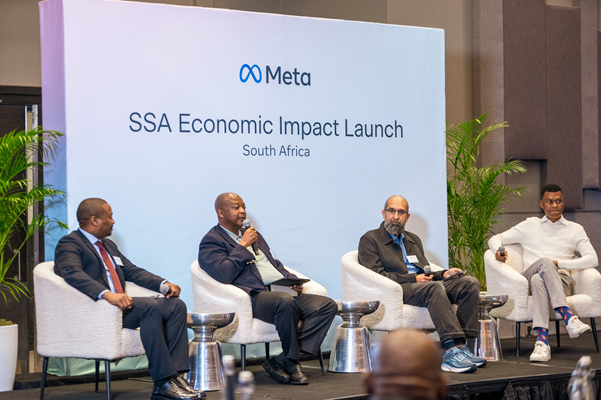
Seen Here: Left to Right Songezo Ralarala, General Manager Regulatory Affairs at MTN. Mothibi Ramusi, Chairperson ICASA. Zunaid Mahomed, Chief Strategy & Growth Officer at Maziv and Thabo at Panel Discussion at the Launch of SSA Economic Impact. Photo Credit: Supplied
South Africa’s digital economy is rapidly emerging as one of the country’s most powerful growth engines, with new independent research revealing that Meta’s platforms are already contributing an estimated R16.5 billion annually to the economy while helping hundreds of thousands of small businesses expand and compete in the digital marketplace.
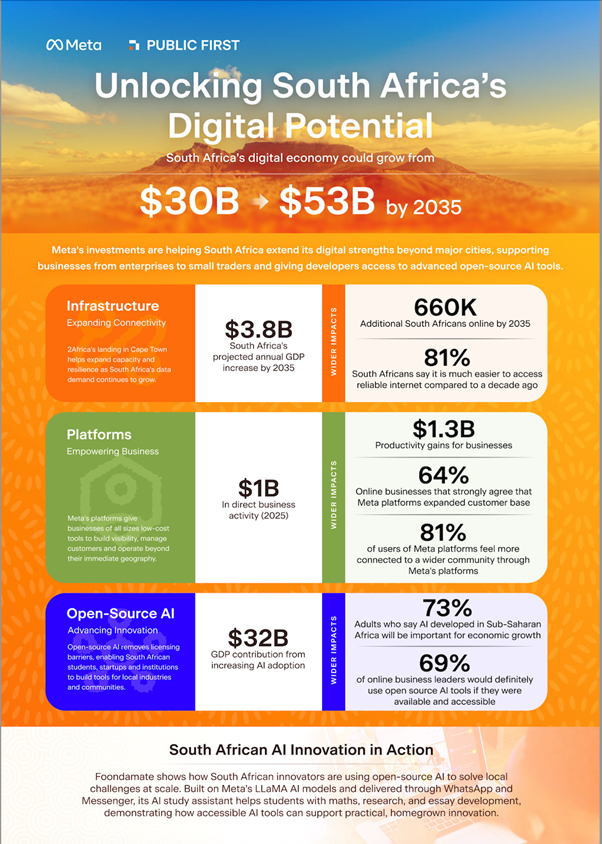
The findings, published in the Meta’s Impact in South Africa report conducted by independent research firm Public First, suggest that South Africa’s digital economy — currently valued at approximately R495 billion — could surge to nearly R874.5 billion by 2035 as digital infrastructure, artificial intelligence and online commerce continue to accelerate.
At the centre of this growth is the widespread use of Meta-owned platforms including Facebook, Instagram, WhatsApp, Messenger, Threads and Meta AI, which have increasingly become critical business tools for South African entrepreneurs, SMEs and informal traders.
According to the report, approximately 910,000 South African small and medium enterprises used Meta’s platforms in 2025 to launch, market and grow their businesses. Collectively, these businesses contributed an estimated R47.9 billion to the country’s GDP.
The research also highlights how instant messaging tools across Meta’s ecosystem are helping businesses reduce operational costs and improve efficiency. Businesses reportedly saved around R21.5 billion through faster and cheaper communication enabled by platforms such as WhatsApp Business and Messenger.
The report paints a picture of a rapidly evolving entrepreneurial ecosystem where digital platforms are helping bridge the gap between South Africa’s formal and informal economies.
From township-based spaza shops to urban design agencies and online retailers, businesses are increasingly relying on digital platforms not only for marketing but also for customer engagement, order management, logistics coordination and payment facilitation.
An overwhelming 90% of online businesses surveyed said Meta’s platforms had enabled them to access new markets and customers beyond their immediate geographical locations.
Meta’s Director of Public Policy for Sub-Saharan Africa, Balkissa Ide Siddo, said the findings demonstrate how digital tools are driving real economic inclusion across South Africa.
“What stands out about South Africa is how our platforms are bridging the gap between the formal and informal economy. When a township trader can use WhatsApp Business to manage orders with the same efficiency as a retailer in Sandton, that is real economic inclusion in action,” she said.
Siddo added that the company’s ongoing investments in digital infrastructure and open-source artificial intelligence technologies are laying the groundwork for South Africa’s next phase of digital growth.
One of the major infrastructure investments highlighted in the report is the 2Africa submarine cable project, backed substantially by Meta, which has already landed in the Western Cape, Eastern Cape and KwaZulu-Natal.
The report estimates that by 2035, the cable could contribute an additional R62.7 billion annually to South Africa’s GDP while bringing approximately 660,000 more people online.
Improved internet accessibility is already being felt across the country, with 94% of online adults surveyed saying access to reliable internet has become significantly easier compared to a decade ago.
Artificial intelligence is expected to become one of the biggest drivers of future economic growth.
The report projects that AI could contribute as much as R528 billion to South Africa’s GDP by 2035 if supported by sufficient investment, infrastructure and innovation.
Importantly, the research shows strong optimism among South Africans regarding Africa-developed AI technologies. About 73% of online South Africans surveyed believe AI developed within Sub-Saharan Africa will play an important role in the continent’s economic future.
Meanwhile, 69% of business leaders indicated they would adopt open-source AI tools if these technologies were easily accessible.
Meta’s open-source AI platforms, including LLaMA and No Language Left Behind, are already helping South African innovators build locally relevant digital solutions without expensive licensing barriers.
One example cited in the report is South African educational technology company Foondamate, which built an AI-powered study assistant using Meta’s LLaMA models. The platform has reportedly reached more than three million learners through WhatsApp and Messenger, providing accessible educational support directly through mobile messaging.
Public First Director Alison Neyle said South Africa is entering a period of significant digital transformation with vast economic upside potential.
“The findings show that Meta’s platforms are helping South African firms grow across formal and informal sectors, supporting entrepreneurship and strengthening participation in one of the world’s most rapidly expanding digital economies,” Neyle said.
“With the right combination of infrastructure, platform access and open-source AI, the upside for South Africa is significant.”
As South Africa continues to pursue economic recovery, job creation and broader digital inclusion, the report positions digital platforms, AI innovation and internet infrastructure as increasingly central pillars of the country’s long-term growth strategy.