

By: Lonwabo Mtyeku Photo Credit: Supplied
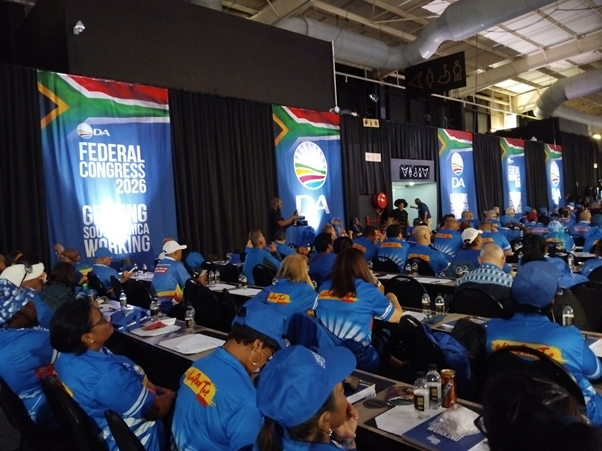
Seen Here: Delegates gather at the Gallagher Convention Centre during the Democratic Alliance Federal Congress 2026, where the party charts a new course on leadership, governance, and its role within South Africa’s coalition era. Photo Credit: Timothy Bernard
The Democratic Alliance (DA) has entered a new and pivotal chapter following its 2026 Federal Congress, held at the Gallagher Convention Centre. Drawing more than 2,000 delegates from across the country, the gathering stands as the largest and arguably most consequential in the party’s history—unfolding against the backdrop of leadership transition, coalition governance, and a shifting national political landscape.
As the DA’s highest decision-making body, the Federal Congress carries the weight of determining leadership, shaping policy direction, and refining the party’s long-term strategy. This year’s proceedings were particularly significant, reflecting the party’s evolution from opposition force to a governing partner within South Africa’s Government of National Unity (GNU).
Leadership Transition Signals a New Era
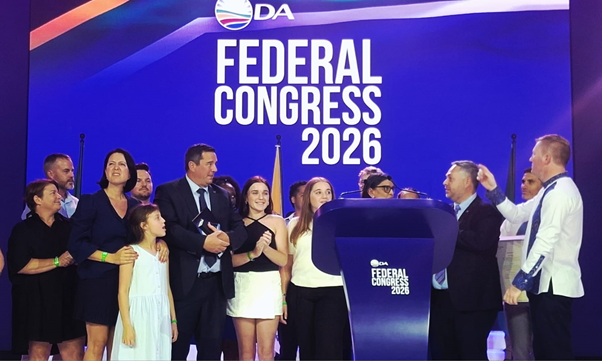
Central to the congress was the election of new leadership following the decision by outgoing federal leader John Steenhuisen not to seek re-election. Steenhuisen’s tenure, which began in 2019, culminated in a historic political shift after the 2024 general elections, where the African National Congress (ANC) lost its parliamentary majority for the first time since 1994.
That electoral outcome ushered in coalition governance at a national level—an unprecedented development in South Africa’s democratic era. Under Steenhuisen, the DA transitioned into a governing partner, a move that fundamentally altered its strategic posture and responsibilities.
The leadership contest that followed has drawn intense interest, with senior figures within the party competing to define its ideological direction and operational priorities. Alongside the federal leader, key positions—including the federal chairperson and deputy chairpersons—are being filled, roles that will be instrumental in shaping the party’s internal cohesion and external positioning.

Policy at the Forefront of Governance Ambitions
Beyond leadership, the congress has placed strong emphasis on policy deliberations, reflecting the DA’s intent to solidify its identity as a governance-driven party. Delegates debated proposals aimed at improving service delivery, strengthening municipal governance, and enhancing institutional accountability.
These discussions come at a critical time, as municipalities across South Africa continue to face infrastructure challenges, financial strain, and service delivery backlogs. The DA’s policy agenda seeks to position the party as a pragmatic alternative capable of implementing solutions rather than merely critiquing governance failures.
This governance-focused approach is increasingly central as the party navigates its role within coalition structures, where policy influence must be balanced with compromise and negotiation.
Navigating the Complexities of Coalition Politics
The DA’s participation in the GNU introduces a nuanced political dynamic. For the first time in its history, the party must balance its identity as a reform-oriented challenger with its responsibilities as a governing partner.
This dual role presents strategic questions: how assertively the DA should pursue its policy agenda within a coalition framework, and how it maintains a distinct political identity while sharing power with former adversaries.
Resolutions adopted at the congress are expected to provide clarity on this balancing act, outlining how the party intends to engage, collaborate, and, where necessary, contest within the GNU.
Electoral Strategy and Municipal Focus
With the 2026 municipal elections on the horizon, the timing of the congress is particularly strategic. The DA is positioning itself to expand beyond its traditional support base, targeting key metropolitan municipalities such as Johannesburg and Tshwane.
The party aims to leverage its governance track record in coalition-led municipalities to secure broader electoral gains. Decisions taken at the congress will directly influence campaign strategy, candidate selection, and coalition-building efforts at local government level. In the longer term, these outcomes are expected to shape the DA’s trajectory heading into the 2029 national and provincial elections.

A Moment of Opportunity and Internal Reflection
Political analysts have described the congress as a moment of both opportunity and introspection. The leadership transition offers the DA a chance to revitalise its image and broaden its appeal, particularly among younger and more diverse constituencies.
At the same time, it has surfaced internal debates around ideology, strategic direction, and the practical realities of coalition governance—debates that will likely continue to shape the party’s evolution.
A Defining Juncture in South African Politics
Ultimately, the DA Federal Congress 2026 represents more than an internal milestone. It reflects a broader transformation within South Africa’s political system, where coalition governance, accountability, and effective service delivery are becoming central to the national discourse.
As the DA recalibrates its identity from opposition to governance, the leadership elected and resolutions adopted in Midrand will not only determine the party’s future direction but also influence its role within the country’s evolving democratic framework.