

By: Lonwabo Mtyeku | Photo Credit: Supplied
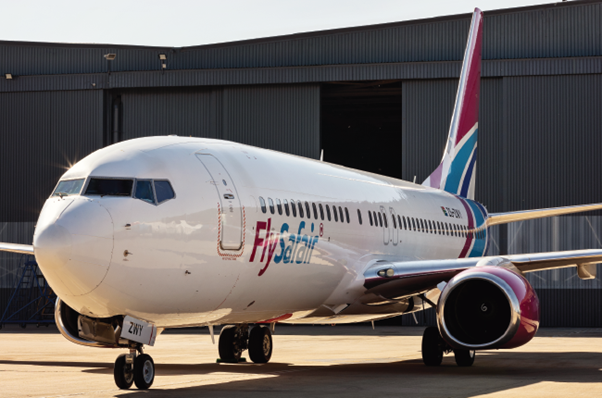
Seen Here: FlySafair reduces its temporary fuel surcharge for a second consecutive week, offering slight relief to travellers as global jet fuel prices begin to ease — though costs remain well above pre-crisis levels. Photo Credit: Supplied
Johannesburg, South Africa — 23 April 2026 — Low-cost carrier FlySafair has announced a second consecutive reduction in its temporary fuel surcharge, offering modest relief to travellers as global jet fuel prices begin to soften following recent volatility.
The airline confirmed that the adjustment reflects a slight decline in Jet A1 fuel costs, which had surged sharply in recent months due to geopolitical tensions in the Middle East. Despite the downward movement, fuel prices remain significantly elevated — still more than double pre-conflict levels — meaning the surcharge will remain in place for the foreseeable future.
Weekly Adjustments Reflect Market Volatility
Introduced in March 2026, the temporary fuel surcharge was positioned as a dynamic pricing mechanism, designed to move in direct response to fluctuations in fuel costs rather than serve as a fixed revenue stream.
According to Kirby Gordon, the airline has remained consistent in its commitment to review and adjust the surcharge every seven days.
“When we introduced this measure, we made it clear that it would be flexible and responsive to real-world fuel pricing,” Gordon said. “These back-to-back reductions demonstrate that commitment in action.”
The surcharge is calculated based on route-specific fuel consumption, meaning passengers may see varying charges depending on the distance and operational requirements of their selected flights.
Fuel Prices Still a Major Pressure Point
While the recent reductions may signal a shift in pricing trends, the broader context remains challenging for airlines globally. Jet A1 fuel — a key cost driver in aviation — continues to trade at historically high levels, placing sustained pressure on operating margins.
Industry analysts note that fuel typically accounts for a significant portion of an airline’s cost base, making even small price fluctuations impactful. The recent spike, triggered by instability in global energy markets, forced carriers like FlySafair to implement temporary measures to remain financially sustainable.

What Travellers Should Expect
For passengers, the evolving surcharge structure introduces both transparency and variability.
FlySafair has outlined several key points for customers:
- No retrospective charges: Bookings made before the surcharge was introduced will not be affected
- Changes may trigger fees: Passengers who modify existing bookings may incur the surcharge if the new travel date falls within the applicable period
- Applies to new bookings: All new reservations on affected routes will include the surcharge until at least 21 August 2026
To enhance transparency, the airline has made weekly updates available on its website, allowing customers to track changes in surcharge levels over time.
Balancing Affordability and Sustainability
FlySafair’s approach reflects a broader challenge facing the aviation sector: balancing cost pressures with customer affordability in an unpredictable global environment.
Unlike permanent fare increases, the temporary surcharge model enables airlines to respond quickly to changing input costs without fundamentally altering base ticket pricing structures. However, it also introduces an element of uncertainty for travellers planning future trips.
Gordon emphasised that the surcharge is not intended to generate additional profit, but rather to offset the direct impact of fuel costs.
“This is not a revenue mechanism,” he said. “It mirrors exactly what we are paying for fuel, and we reduce it as soon as conditions allow.”
Global Context Driving Local Impact
The ongoing volatility in fuel pricing is closely tied to geopolitical developments, particularly in energy-producing regions. Disruptions in supply chains and heightened market uncertainty have contributed to sustained price pressure, affecting airlines worldwide.
For South African carriers, these global dynamics are compounded by currency fluctuations and local operating conditions, further influencing pricing decisions.
Looking Ahead
While the latest reductions are a positive signal, industry observers caution that full normalisation of fuel prices may take time. As a result, travellers should expect the surcharge to remain in place until there is greater stability in global energy markets.
FlySafair has confirmed that it will continue its weekly review cycle, adjusting the surcharge in line with real-time fuel costs. This approach aims to strike a balance between operational sustainability and fairness to customers.
A Transparent Approach in Uncertain Times
In an environment where rising costs are often passed on to consumers with limited explanation, FlySafair’s decision to implement a transparent, adjustable surcharge model represents a notable shift toward greater accountability in airline pricing.
For now, travellers can take some comfort in the recent downward adjustments — even as the broader outlook remains uncertain.
As global fuel markets continue to evolve, the airline’s ability to maintain this responsive approach will be key in navigating the months ahead, while keeping South Africans connected at the most competitive prices possible.