
Day One challenges business leaders to move beyond representation and build systems that unlock women-led growth across Africa
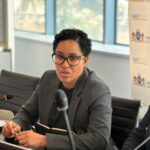
Seen Here: Simone Cooper (Head of Business and Commercial Banking at Standard Bank South Africa) speech from her address from this morning at the Standard Bank Top Women Conference. Photo Credit: Supplied
JOHANNESBURG — The need to turn women’s potential into tangible economic opportunity took centre stage at the Standard Bank Top Women Conference 2026 on Tuesday, as business leaders, entrepreneurs and changemakers gathered to examine how stronger systems can accelerate women-led growth across Africa.
Held at the Sandton Convention Centre on 8–9 September under the theme “Her Power. Africa’s Future. Amplifying Women-Led Growth,” the conference is placing a strong emphasis on moving beyond representation towards meaningful participation, influence and economic impact.
Addressing delegates on Day One, Simone Cooper argued that Africa’s economic future will depend not simply on recognising the capabilities of women, but on creating the conditions that allow those capabilities to translate into sustainable growth.
“Africa’s future is not decades away, it is already here.”
She pointed to Africa’s rapidly growing young population as a significant economic opportunity, noting that by 2030, Africans are expected to account for 40% of the world’s young people.
Research cited in the address indicates that increasing the economic participation of young women could unlock as much as US$287 billion in additional GDP and create 23 million jobs across Africa by 2030.
The message was clear: investment in women should no longer be viewed solely through the lens of inclusion or social responsibility, but as a fundamental economic strategy.
“Investing in women is not simply a matter of inclusion. It is one of the smartest economic choices a continent can make.”
From exceptional women to exceptional systems
A central argument of the address was that Africa cannot rely on individual women overcoming structural barriers through extraordinary resilience.
“Why should exceptional success still require extraordinary resilience?”
The speaker challenged businesses and institutions to rethink how opportunity is created, arguing that the objective should be to build systems in which women can succeed without having to overcome unnecessary structural obstacles at every stage of their careers and businesses.
“Our ambition cannot simply be to produce a few extraordinary women. Our ambition must be to create extraordinary systems that enable millions of women to succeed.”
The conference programme reflects that broader focus, with discussions covering women-led businesses, access to networks, technology, data, entrepreneurship, supplier development and pathways into leadership.
AI presents both opportunity and responsibility
Technology and artificial intelligence also emerged as critical components of the conversation around women’s economic participation.
Rather than viewing women as passive participants in technological change, the address called for women to play a central role in shaping the future AI economy.
“Women must not simply participate in the AI economy. They must help build it, design it, lead it and govern it.”
The call comes as businesses increasingly consider how AI and digital transformation will reshape employment, entrepreneurship and competitiveness.
For women-led businesses in particular, access to technology, data, finance and markets could determine whether enterprises remain small or gain the capacity to scale.
From mentorship to sponsorship
Another key theme was the importance of networks and the distinction between mentorship and sponsorship.
The speaker argued that while mentorship remains valuable, women need more leaders willing to actively use their influence to create opportunities.
“Mentors share advice and wisdom. Sponsors use their influence to create opportunity.”
That means opening doors, advocating for emerging leaders, making strategic introductions and creating pathways into rooms where important decisions are made.
The principle was framed as a broader definition of leadership:
“Leadership is not measured by how far we climb. It is measured by how many people we help rise alongside us.”
The address also highlighted the importance of community in creating sustainable pathways for women to advance.
“Talent may open the door, but community helps us walk through it.”
Building Africa’s next generation of women leaders
The conference’s emphasis on education, entrepreneurship and leadership reflects the need to intervene much earlier in the talent pipeline.
Women’s potential, the speaker argued, is already visible in classrooms, businesses and boardrooms. The challenge is ensuring that potential is connected to opportunity.
The Standard Bank Top Women Conference programme includes conversations on girls’ education, women-led business communities, strategic networking and the systems required to remove barriers to women’s advancement.
The 2026 programme also features the national finale of the Standard Bank Top Women EmpowHER Pitching Den, bringing together regional entrepreneurial winners to pitch their businesses before an expert judging panel.
From barriers to bridges
The broader message from Day One was that women’s economic advancement cannot be treated as a peripheral issue.
It is an economic imperative.
The speaker closed with a challenge to institutions, businesses and leaders to build stronger pathways between education, entrepreneurship and leadership while using technology to expand access and turning mentorship into active sponsorship.
“The future of Africa will not be determined by what women are capable of achieving. That capability is already evident all around us.”
Instead, she argued, Africa’s future will be shaped by whether its institutions are prepared to remove the barriers that prevent more women from converting capability into influence, businesses into jobs and ambition into economic growth.
As the Standard Bank Top Women Conference continues, the central question is therefore shifting from whether women have the power to shape Africa’s future to whether the systems around them are ready to unlock it.