
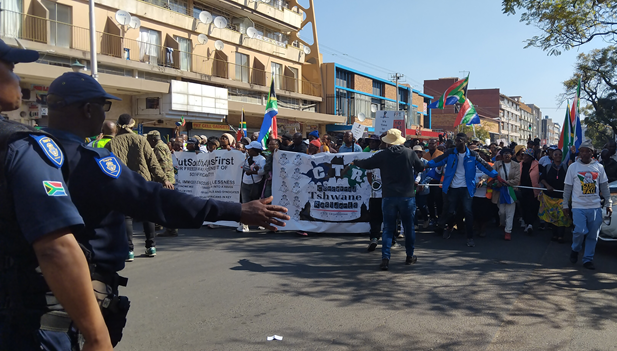
Seen Here: Thousands of demonstrators gathered across Tshwane on 30 June 2026, calling for stronger immigration enforcement while highlighting growing public concern over unemployment, service delivery and economic opportunity. Photo Credit: Community Newsroom
The nationwide demonstrations that unfolded on 30 June 2026, including large-scale marches across Gauteng, were about far more than immigration. They exposed a country grappling with economic frustration, declining public confidence in state institutions and increasingly polarised political discourse.
Organised under the banner of March and March and supported by several anti-illegal immigration groups, the demonstrations called for stronger action against undocumented migrants. While organisers maintained that their campaign targeted illegal immigration rather than foreign nationals generally, the protests unfolded against a backdrop of heightened tensions, widespread fear among migrant communities and an extensive security operation aimed at preventing violence.
Although much of the protest action remained peaceful, isolated incidents of looting, intimidation and business disruption were reported in parts of Gauteng, reinforcing concerns about the fragile relationship between economic hardship and social unrest.
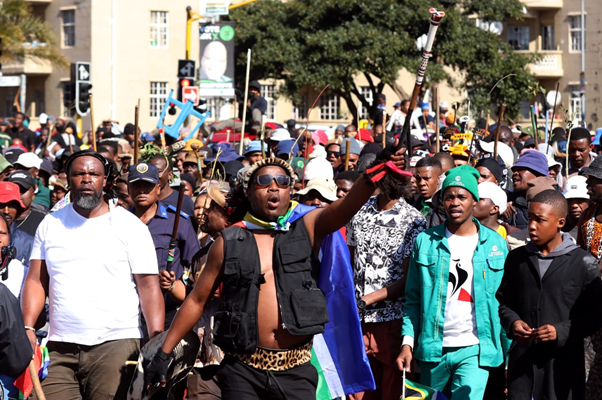
Seen Here: Demonstrators marched through Johannesburg as part of the nationwide 30 June protests, highlighting the growing intersection of immigration, economic pressures and public policy in South Africa’s national conversation. Photo Credit: Supplied
An Economy Under Pressure
At its core, the demonstrations reflected the frustration of many South Africans facing persistently high unemployment, rising living costs and limited economic opportunities.
For many protesters, undocumented immigration has become symbolic of broader frustrations surrounding scarce jobs, pressure on public services and concerns over law enforcement. However, economists and migration experts have consistently cautioned that South Africa’s economic challenges are driven by far more complex structural factors, including slow economic growth, energy constraints, skills shortages and inequality.
The protests therefore highlighted a broader reality: when economic growth slows and unemployment remains stubbornly high, public anger often seeks visible targets.
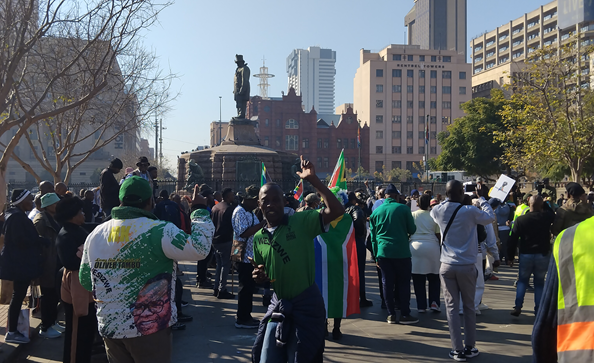
Seen Here: Law enforcement maintained a visible presence as marchers moved through Tshwane during the 30 June demonstrations, with authorities working to ensure the protests remained peaceful and orderly. Photo Credit: Community Newsroom
Political Consequences
Politically, the marches placed renewed pressure on government to demonstrate that it can effectively manage immigration while simultaneously protecting constitutional rights and maintaining public order.
President Cyril Ramaphosa and provincial leaders repeatedly appealed for peaceful demonstrations, emphasising that immigration enforcement remains the responsibility of the state and warning against vigilantism. Authorities deployed significant policing resources to prevent a repeat of previous episodes of unrest.
The demonstrations also revealed how immigration has become an increasingly prominent political issue ahead of future electoral contests. Parties and civic movements across the political spectrum are likely to face growing pressure from voters demanding stronger border management, faster documentation processes and more visible enforcement of immigration laws.
At the same time, political leaders face the difficult task of responding to legitimate public concerns without allowing frustration to fuel xenophobia or undermine South Africa’s constitutional commitment to human rights.
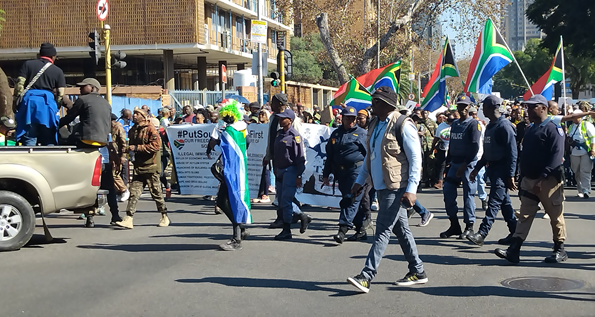
Seen Here: Protesters marched through the streets of Tshwane on 30 June 2026, voicing concerns over economic hardship, unemployment and immigration enforcement, as the capital became one of the focal points of the nationwide demonstrations. Photo Credit: Community Newsroom
The Economic Cost of Uncertainty
Even where protests remain largely peaceful, uncertainty carries an economic price.
Several businesses reduced trading hours, some retailers temporarily closed their doors, and transport disruptions affected parts of Gauteng as companies implemented contingency plans. Such disruptions may be short-lived, but they reinforce investor concerns about policy certainty, social stability and the cost of doing business in South Africa.
For township businesses and small enterprises operating on narrow margins, even a single day of reduced economic activity can have meaningful financial consequences.
More broadly, images of heightened tensions can affect tourism, investor confidence and South Africa’s international reputation, particularly when concerns about violence dominate global headlines.
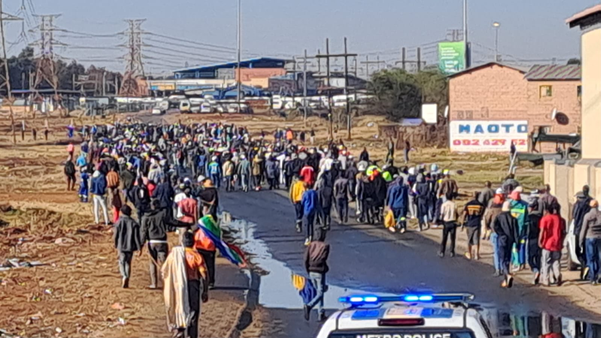
Seen Here: Residents and community organisations joined the 30 June march in Ekurhuleni, where demonstrators called for government action on border management, public safety and economic challenges affecting local communities. Photo Credit: Supplied
Beyond Immigration
Perhaps the most important lesson from 30 June is that the demonstrations were ultimately about more than immigration policy.
They reflected deeper questions about governance, service delivery, public trust and economic inclusion.
South Africans are demanding effective institutions capable of securing borders, enforcing the law consistently, creating jobs and delivering sustainable economic growth. These challenges cannot be solved through protest alone, nor can they be addressed by focusing on immigration in isolation.
Long-term stability will depend on expanding economic opportunity, improving public administration, attracting investment and restoring confidence that government institutions can respond effectively to citizens’ concerns.
A Defining Moment
The events of 30 June 2026 may well be remembered as a defining political moment—not simply because thousands marched, but because the demonstrations exposed the widening gap between public expectations and economic reality.
Whether that moment becomes a catalyst for constructive policy reform or a deeper source of political division will depend on what follows.
The challenge now is not only to preserve public order but to address the underlying economic conditions that continue to fuel frustration. Without meaningful progress on jobs, inclusive growth and institutional effectiveness, the grievances that brought thousands onto South Africa’s streets are unlikely to disappear.
The march may have ended, but the debate over South Africa’s economic future, immigration policy and social cohesion has only just begun.