


By: Lonwabo Mtyeku | Photo Credit: Community Newsroom

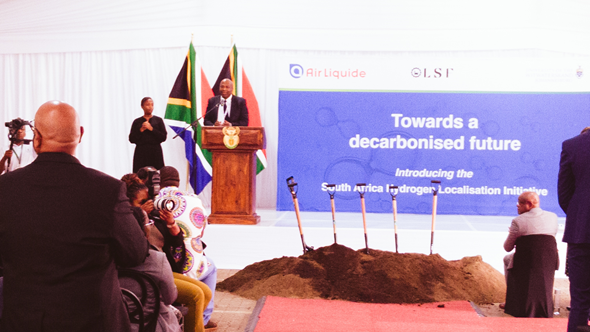
Seen Here: Deputy President Paul Mashatile officiates the launch of the Strategic Hydrogen Localisation Investment Facility at Wits University, underscoring South Africa’s commitment to building a competitive green hydrogen economy.
Johannesburg, 26 February 2026 – Deputy President Paul Mashatile has officially launched the Strategic Hydrogen Localisation Investment Facility at the University of the Witwatersrand (Wits), describing the initiative as a decisive step toward positioning South Africa as a competitive player in the global green hydrogen economy.
The launch ceremony, held at Wits University, brought together government leaders, industry stakeholders, researchers, and investors to mark the establishment of the R100 million facility. The initiative is designed to accelerate localisation across the hydrogen value chain, strengthen domestic manufacturing capabilities, and catalyse investment into hydrogen-related technologies and infrastructure.
Advancing the Hydrogen Economy
In his address, Deputy President Mashatile underscored the strategic importance of green hydrogen within South Africa’s broader energy transition framework. He noted that hydrogen—particularly when produced using renewable energy sources—offers significant potential to decarbonise hard-to-abate sectors such as heavy industry, freight transport, and mining.
The facility forms part of the country’s evolving Hydrogen Society Roadmap, which aims to leverage South Africa’s comparative advantages, including abundant renewable energy resources and substantial platinum group metals (PGMs) reserves. PGMs are critical components in hydrogen fuel cells and electrolyser technologies, positioning the country to integrate mineral beneficiation with clean energy industrialisation.
Mashatile emphasised that localisation is central to ensuring that the hydrogen economy generates domestic value rather than merely exporting raw materials or importing finished technologies. By supporting local component manufacturing, skills development, and technology transfer, the investment facility seeks to build a sustainable industrial ecosystem around hydrogen production and utilisation.
A University-Industry-Government Collaboration
Hosted at Wits University, the facility represents a collaborative model that integrates academic research, industrial application, and public policy. Universities are expected to play a critical role in advancing applied research, innovation, and human capital development to support the emerging sector.
Wits researchers have been actively engaged in energy research and hydrogen technologies, and the establishment of the investment facility is intended to strengthen research-commercialisation pathways. The initiative is also expected to support postgraduate training and technical capacity-building in fields such as chemical engineering, materials science, energy systems, and industrial design.
Government officials at the launch highlighted the importance of partnerships between academia, state entities, and private sector investors in ensuring that South Africa captures a meaningful share of global hydrogen markets.
Economic and Industrial Impact
The Strategic Hydrogen Localisation Investment Facility is positioned not only as an environmental intervention but also as an industrial policy instrument. By anchoring hydrogen-related manufacturing locally, the initiative aims to stimulate job creation, enterprise development, and export diversification.
South Africa’s participation in the global hydrogen economy is increasingly viewed as a mechanism for economic modernisation and re-industrialisation. The localisation focus is expected to enhance competitiveness in areas such as fuel cell assembly, electrolyser component manufacturing, and hydrogen storage technologies.
Deputy President Mashatile reiterated that the initiative aligns with national priorities around inclusive growth, energy security, and climate resilience. He noted that a just energy transition must balance decarbonisation objectives with economic opportunity, ensuring that communities and workers benefit from new industries.
Looking Ahead
The launch of the Strategic Hydrogen Localisation Investment Facility marks a tangible milestone in South Africa’s clean energy trajectory. With international demand for green hydrogen projected to rise significantly over the coming decades, the country is seeking to position itself as both a producer and a technology hub.
As implementation begins, stakeholders will focus on scaling pilot projects, mobilising further capital, and integrating hydrogen initiatives into broader infrastructure planning.
The event at Wits University signals a growing commitment to embedding innovation within South Africa’s industrial landscape. Through strategic investment and coordinated policy execution, the hydrogen sector may become a cornerstone of the country’s future economic architecture.


