By: Lonwabo Mtyeku | Photo Credit: Community Newsroom
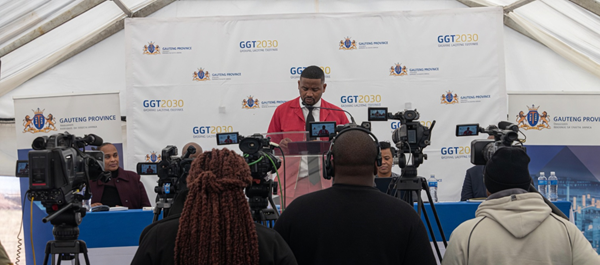
Seen Here: Gauteng MEC for Finance Nkululeko Dunga addresses the media at Dube Hostel in Soweto, outlining the province’s financial challenges, mounting municipal debt and plans to restore fiscal discipline across Gauteng. Photo Credit: Community Newsroom
The Gauteng Provincial Government is confronting mounting financial pressure, growing municipal debt, collapsing infrastructure, rising unemployment and billions in unresolved irregular expenditure, according to Gauteng MEC for Finance Nkululeko Dunga.
Delivering an extensive and politically charged media briefing at Dube Hostel in Soweto on Thursday, Dunga painted a sobering picture of the province’s financial state while outlining an ambitious programme of action aimed at restoring fiscal discipline, rebuilding state capacity and improving service delivery.
The briefing, deliberately held in Soweto rather than a corporate or government venue, was framed as a direct act of accountability to ordinary residents.
“The finances of Gauteng do not only belong to boardrooms, markets, investors and financial institutions,” Dunga said. “The finances of Gauteng belong to the people.”
A Province Under Economic Strain
Dunga said Gauteng remains South Africa’s economic engine, contributing more than a third of the country’s GDP, yet the province faces escalating social and economic pressures driven by unemployment, migration, deteriorating infrastructure and increasing demand for public services.
The MEC warned that global instability, particularly conflict in the Middle East, rising fuel prices and weakening international growth projections, are compounding domestic economic challenges.
According to Dunga, South Africa’s economy grew by only 1.1% in 2025, while unemployment has surged to crisis levels. He noted that Gauteng’s expanded unemployment rate now stands at 40.6%, with millions of South Africans remaining economically excluded.
“These figures are not abstract statistics,” he said. “They represent households without income, young people without opportunities, and growing pressure on the state.”
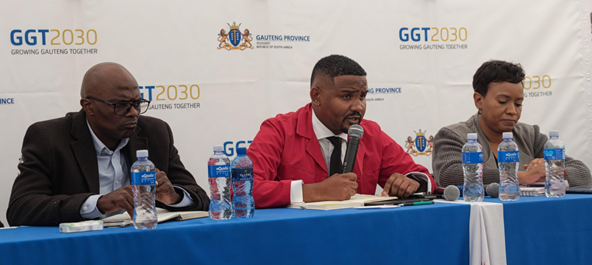
Seen Here: Nkululeko Dunga delivers a detailed briefing on Gauteng’s economic outlook and budget pressures, warning that unemployment, infrastructure decay and rising debt continue to threaten service delivery across the province. Photo Credit: Community Newsroom
Gauteng’s R179 Billion Budget Under Pressure
Dunga revealed that Gauteng is implementing a provincial budget of approximately R179.2 billion for the 2026/27 financial year under increasingly constrained fiscal conditions.
Education and Health continue to dominate provincial spending, together consuming more than R137 billion, or roughly 77% of the total budget.
Despite this significant expenditure, communities continue to experience overcrowded classrooms, deteriorating hospitals, medicine shortages and inadequate infrastructure.
The MEC acknowledged that Gauteng’s finances are heavily dependent on national equitable share allocations and conditional grants, despite the province carrying the burden of rapid urbanisation and migration.
E-Tolls Debt Continues to Haunt Gauteng
One of the biggest fiscal burdens remains the Gauteng Freeway Improvement Project (GFIP) and the e-tolls debt settlement arrangement.
Dunga disclosed that the province has already paid approximately R9.28 billion towards the settlement, with another R10.8 billion still outstanding.
Of immediate concern is a looming R4.64 billion payment due at the end of June 2026.
The MEC warned that these obligations are placing enormous strain on provincial liquidity and infrastructure planning.
Billions in Irregular Expenditure
Among the most alarming revelations was the scale of unresolved irregular expenditure across provincial departments and entities.
Dunga confirmed that Gauteng is currently carrying approximately R36.5 billion in historical irregular expenditure, with the largest balances concentrated in Health, Education and Human Settlements.
Health alone accounts for around R22.8 billion.
While he clarified that irregular expenditure does not automatically mean money was stolen, he admitted the figures expose “serious and systemic weaknesses” in procurement, contract management and financial oversight.
“There must be immediate strengthening of financial controls, consequence management and institutional accountability,” he said.
“Heads must roll where necessary.”
Unpaid Invoices Crushing Small Businesses
The MEC also highlighted the growing crisis of unpaid invoices and accruals across government departments.
As of March 2026, Gauteng departments collectively owed approximately R9.3 billion in accruals and unpaid commitments, with nearly R5 billion already overdue beyond 30 days.
Dunga warned that delayed payments are devastating township businesses and small enterprises that rely on government contracts.
“The direct consequence of this situation is collapsing businesses, job losses and declining confidence in the state’s ability to honour its obligations,” he said.
Municipal Finances Near Breaking Point
Municipal finances across Gauteng were described as another major threat to economic stability.
Municipalities collectively reported debtors amounting to roughly R173.3 billion, while under-reporting billions owed to Eskom and Rand Water.
The province also faces growing intergovernmental debt disputes, with municipalities owing Gauteng approximately R2.5 billion in unpaid motor vehicle licensing revenue, while provincial government itself owes municipalities around R2.64 billion.
Dunga criticised weak financial reporting systems, unfunded municipal budgets and governance failures in several municipalities, including Emfuleni, Sedibeng, Lesedi and Merafong.
The MEC further expressed concern over the City of Ekurhuleni’s budget adoption processes, warning that municipalities cannot continue operating with structurally weak budgets while infrastructure collapses.
Treasury Overhaul and New Revenue Measures
Dunga announced that Gauteng Provincial Treasury itself will undergo institutional reform, including the filling of about 40 critical posts and the strengthening of governance systems.
The province is also exploring new revenue collection mechanisms, including direct provincial payment platforms aimed at reducing leakages in motor vehicle licensing and other revenue streams.
Additional focus areas include:
- Strengthening debt recovery systems
- Improving hospital billing collections
- Tackling revenue leakages
- Enhancing digital procurement oversight
- Expanding infrastructure maintenance capacity
The MEC also proposed expanding artisan development programmes to rebuild technical state capacity using electricians, plumbers, welders and mechanics to repair public infrastructure.
Concern Over Attacks on Financial Officials
In one of the briefing’s most emotional moments, Dunga addressed the growing intimidation and assassinations of officials involved in anti-corruption and financial oversight work.
He referenced the killings of Babita Deokaran, Mani Martha and Mpho Molefe as examples of the dangers facing ethical public servants.
“Until government decisively confronts criminal networks, corruption and intimidation directed at financial officials, long-term stabilisation of public finances will remain under threat,” he warned.
“Imali Yeyabahlali”
Dunga concluded by reaffirming government’s commitment to taking financial transparency directly to communities through public participation programmes branded “Imali Yeyabahlali” and “Chelete ke YaBatho”.
He stressed that public finance management cannot simply be measured through accounting systems and audit reports.
“The success of public finance management will ultimately be measured by whether communities experience improvements in schools, clinics, roads, housing, transport and public safety,” Dunga said.
As Gauteng grapples with rising debt, strained infrastructure and economic uncertainty, the province now faces the difficult task of restoring financial credibility while meeting the growing demands of more than 16 million residents.