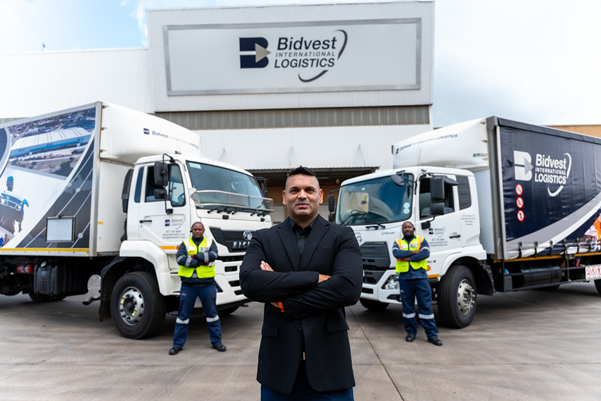
Seen Here: Seeing further. Responding earlier. Moving South Africa forward. During Transport Month, Marcus Ellappan, Overland Logistics Director at Bidvest International Logistics, highlights the power of visibility, technology and human judgement in building safer, smarter and more efficient logistics networks. Because every journey carries more than cargo — it carries responsibility, opportunity and the future of the economy. Photo Credit: Supplied
JOHANNESBURG — In a logistics network, the risks that cannot be seen are often the risks that cost the most.
As supply chains become more interconnected, time-sensitive and vulnerable to disruption, operational visibility is evolving from a customer-service convenience into a critical capability for managing risk, protecting performance and improving decision-making.
For South Africa, the stakes are particularly high.
At the inaugural National Transport Conference in March 2026, President Cyril Ramaphosa noted that around 69% of the country’s freight moves by road, while logistics inefficiencies are estimated to cost the economy close to R1 billion a day.
Against that backdrop, even seemingly minor operational blind spots can have significant consequences — from an inefficient route or excessive idling to an unsafe driving behaviour, a delayed shipment or a recurring problem that goes undetected because the right information is not available.
According to Marcus Ellappan, Overland Logistics Director at Bidvest International Logistics (BIL), the real value of operational data is not simply being able to see what is happening. It is being able to act before an exception becomes a larger problem.
“Innovation should not be measured by how many systems we introduce. What matters is whether those systems help us identify risk earlier, make better decisions and deliver a more reliable operation.”
Turning visibility into intervention
Modern logistics operations generate enormous volumes of information, but information only becomes valuable when it leads to better decisions.
At BIL, technologies and operational controls including live vehicle tracking, 24-hour risk and operational control, in-vehicle CCTV and driver monitoring provide greater insight into activity across the road network.
This can allow teams to identify behavioural and operational exceptions — including speeding, harsh braking and excessive idling — at an earlier stage.
The benefit is not simply improved oversight. Early identification creates an opportunity to intervene before an issue escalates into a safety incident, service disruption or unnecessary operating cost.
Ellappan argues that this is where technology and operational discipline intersect.
“Safety cannot depend on what happens after an incident. A mature operation must identify risk early enough to act.”
He says this requires more than data.
“That requires the right information, but also training, accountability and people who are prepared to act on what the data is telling them.”
Safety as an operating principle
For transport and logistics businesses, safety is often associated with compliance, policies and procedures. But increasingly, it is also becoming a measure of operational maturity.
A business that can identify unsafe behaviour before it results in an incident is operating differently from one that only responds after something has gone wrong.
That makes safety data a strategic asset rather than simply a reporting tool.
The same principle applies to service delivery. Automated delivery tracking, digital proof-of-delivery systems, route optimisation and shipment-status visibility can reduce uncertainty while allowing logistics teams and customers to respond more quickly when something deviates from plan.
The objective, however, should not be the accumulation of more technology.
“The objective is not more technology. It is better operational judgement.”
Sustainability hidden in the data
Operational visibility can also reveal another category of inefficiency: the unnecessary movement, fuel consumption and resource use embedded in daily logistics activity.
Excessive idling, inefficient routing, poor vehicle utilisation and suboptimal load planning can increase costs while simultaneously increasing environmental impact.
Identifying those inefficiencies creates an opportunity to address both challenges at the same time.
Measures such as fleet optimisation, green-band driving, improved load planning, solar installations and LED warehouse lighting demonstrate how sustainability can increasingly be integrated into routine operational decision-making rather than treated as a separate objective.
The result is a more compelling business case for sustainability: less waste, lower operating costs and better asset utilisation.
People remain the critical link
Yet even the most advanced technology cannot eliminate every blind spot.
Data can highlight an anomaly, but it cannot always explain why it occurred. Nor can a dashboard take responsibility for the operational decision that follows.
That remains a human function.
For that reason, Ellappan places continued emphasis on training, accountability, cross-functional collaboration and employee confidence.
A sophisticated logistics environment depends on people who can interpret information, understand operational context and challenge processes when something does not appear right.
Technology may identify the exception, but people determine the response.
Seeing further, responding earlier
The broader transformation taking place across logistics is therefore not simply about digitising operations. It is about creating networks that can identify emerging risks earlier, respond faster and make better use of every available resource.
For BIL, that philosophy is reflected in its ambition to go beyond the traditional boundaries of logistics performance — pursuing networks that are safer, more visible, more efficient and more sustainable.
As South Africa continues to grapple with the cost and complexity of moving goods, the ability to see what is happening across the network is becoming increasingly important.
Because when every unnecessary kilometre, delayed shipment, unsafe action and operational inefficiency carries a cost, visibility is not merely about knowing where the network is. It is about knowing when to act.
In modern logistics, seeing further means responding earlier — and the difference can be measured in safety, service, efficiency and cost.