

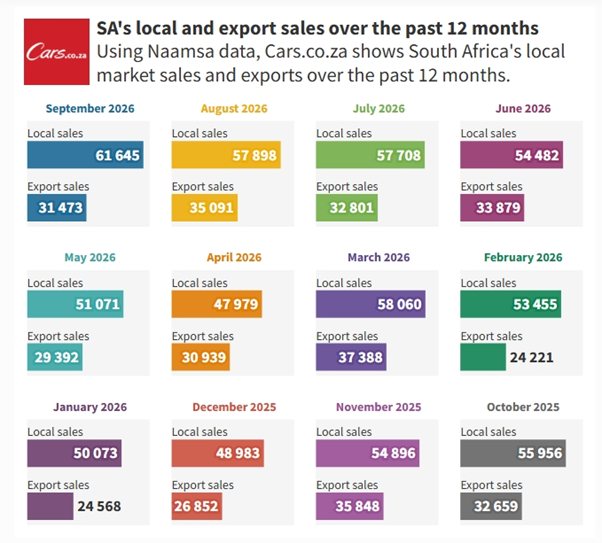
JOHANNESBURG, SEPTEMBER 2026 — South Africa’s new-vehicle market has delivered one of its strongest performances in years, with 61,645 vehicles sold in September, marking a 12.7% year-on-year increase and extending the industry’s run of uninterrupted annual growth to 24 consecutive months.
The September result was significant on several fronts. It not only eclipsed the previous 2026 monthly high recorded in March, but also pushed total monthly sales beyond the 60,000-unit threshold — a level the market has not crossed for several years.
The performance provides further evidence of resilient consumer demand despite persistent economic pressures, with motorists increasingly weighing affordability, running costs and overall value when making purchasing decisions.
Alan Quinn, Chief Innovation and Product Officer at Cars.co.za, said the latest numbers reflected the underlying strength of the local market.
“In September 2026 the new-vehicle market in South Africa surpassed the 60,000-unit mark and achieved its 24th month in a row of year-on-year growth,” said Quinn.
He said the milestone demonstrated the strength of local demand even as economic challenges continued to influence consumer behaviour.
“Consumer preference is shifting more and more to affordability and value in all vehicle segments,” he added.
Toyota dominates as market gathers pace
At the head of the sales table, Toyota South Africa Motors, including Lexus and Hino, delivered a standout performance.
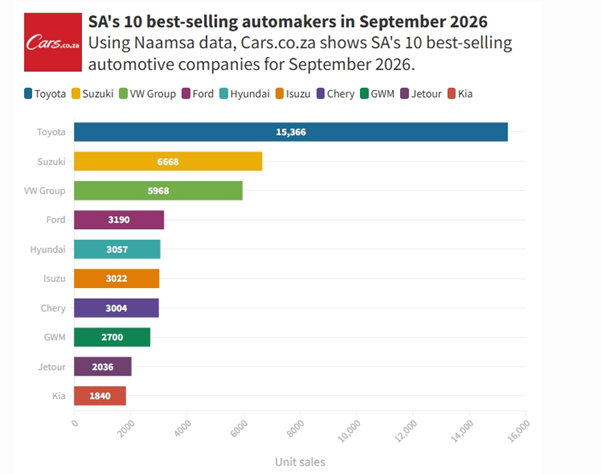
Toyota sold 15,366 units, breaking through the 15,000-unit mark for the first time since March 2022 and claiming a commanding 24.9% share of the total market.
The manufacturer’s sales were also 11.2% higher than the previous month, reinforcing its position as South Africa’s dominant automotive brand.
September’s top 10 automakers were:
| Position | Automaker | Units sold | Month-on-month change |
| 1 | Toyota | 15,366 | +11.2% |
| 2 | Suzuki | 6,668 | +2.5% |
| 3 | Volkswagen Group | 5,968 | +5.3% |
| 4 | Ford | 3,190 | -0.4% |
| 5 | Hyundai | 3,057 | +0.8% |
| 6 | Isuzu | 3,022 | +19.4% |
| 7 | Chery | 3,004 | +8.7% |
| 8 | GWM | 2,700 | +4.1% |
| 9 | Jetour | 2,036 | +4.3% |
| 10 | Kia | 1,840 | +3.2% |
Suzuki, Isuzu and Chery make their mark
Suzuki maintained second place after recording its best monthly sales performance of the year, moving 6,668 units.
One of the month’s biggest movers was Isuzu, which increased sales by 19.4% month on month to 3,022 units, allowing it to leapfrog both Chery and GWM into sixth position.
Chery also reached an important milestone, exceeding 3,000 units for the first time with 3,004 vehicles sold. Despite the achievement, the brand slipped to seventh place.
Ford retained fourth position with 3,190 units, while Hyundai remained fifth after selling 3,057 vehicles.
The figures underline the growing competitiveness of South Africa’s automotive market, where established Japanese, European and Korean manufacturers are increasingly being challenged by rapidly expanding Chinese brands.
Passenger and commercial sectors both strengthen
The September growth was broad-based across key segments.
Passenger-vehicle sales increased by 14.7% year on year to 44,291 units, although rental fleets accounted for approximately 18.4% of those sales.
The light-commercial vehicle sector also performed strongly, with registrations rising 9.6% year on year to 14,361 units.
The strength of these segments suggests that demand is being supported not only by private buyers but also by commercial operators and fleet activity.
Export market remains under pressure
While the domestic market continued to strengthen, the export picture was considerably less positive.
Vehicle exports declined by 18.8% year on year to 31,473 units, highlighting the continued impact of international demand conditions and supply-chain pressures on South Africa’s vehicle manufacturing industry.
The divergence between stronger domestic sales and weaker exports remains an important trend to watch as manufacturers navigate an increasingly uncertain global automotive environment.
Affordability remains the defining theme
Despite the headline growth, industry stakeholders remain mindful of the economic pressures facing South African consumers.
Brandon Cohen, chairman of the National Automobile Dealers’ Association (NADA), described the September figures as encouraging, saying the stronger third-quarter performance provided dealers and manufacturers with a positive platform for the final stretch of the year.
But the next phase of growth, he indicated, will depend on matching vehicles and financing solutions with what consumers genuinely want — and can afford.
That challenge is becoming increasingly important as motorists contend with elevated borrowing costs alongside pressure from fuel and broader living expenses.
Thanda Sithole, Senior Economist at FNB and WesBank, said demand had remained resilient despite these headwinds.
Naamsa, meanwhile, cautioned that the macroeconomic environment had become more difficult, with rising energy costs placing additional pressure on household budgets.
Yet the organisation believes the market’s resilience is being supported by a more competitive and diverse automotive landscape, giving buyers a wider range of price points, vehicle types and value propositions.
A market entering its final quarter with momentum
September’s numbers provide the South African motor industry with a welcome dose of momentum heading into the final quarter of the year.
The more important story, however, may be what lies beneath the headline sales figure.
Consumers are still buying cars, but increasingly with a sharper eye on value, affordability, financing and total ownership costs. Manufacturers that can deliver compelling products without stretching household budgets too far are likely to remain best positioned.
For now, 61,645 units and 24 consecutive months of year-on-year growth represent a remarkable turnaround for a market that has spent years navigating economic uncertainty.
The road ahead may still be challenging, but September has shown that South Africa’s automotive market is travelling in the right direction — and with considerable momentum.