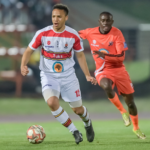
Seen Here: 🏆⚽🏆 Where dreams meet determination. Young footballers from across South Africa take centre stage at the 2026 Kay Motsepe Schools Football Championship National Finals in Soshanguve, competing for glory while embracing the bigger lessons of discipline, education, teamwork and opportunity. On the pitch, they chase the trophy. Beyond it, they are building their future. 🇿🇦✨ Photo Credit: Supplied
Football, education and character development take centre stage as South Africa’s leading school football tournament brings together 36 schools in Soshanguve
SOSHANGUVE, PRETORIA — The 2026 Kay Motsepe Schools Football Championship National Finals have kicked off at Giant Stadium in Soshanguve, bringing together some of South Africa’s most promising young footballers while placing a strong emphasis on a principle that extends beyond the football pitch: education remains the foundation for long-term success.
Now in its 22nd edition, the championship is sponsored by the Motsepe Foundation in partnership with Sanlam, the Department of Basic Education, the Department of Sport, Arts and Culture, and the South African Football Association (SAFA).
The national finals feature 36 school teams and more than 576 players competing across the Under-13 Girls, Under-13 Boys and Under-19 Boys divisions. Beyond the pursuit of national honours, participating schools are competing for prize funding that can be invested in educational and sporting infrastructure.
The tournament therefore occupies a significant space at the intersection of youth development, education and sport, providing learners with an environment in which sporting ambition can coexist with academic responsibility.
Football as a Platform for Opportunity
Former Kaizer Chiefs coach Ernst Middendorp, who currently serves as Director of Football at Gqeberha-based private school Urban Academy, highlighted the important role school football can play in creating pathways for young players.
Middendorp noted that professional football structures do not necessarily provide development opportunities for every young player at every age group, making school-based competitions an important part of South Africa’s football development ecosystem.
“Not all PSL teams have junior setups at these age groups, so the Kay Motsepe Schools Championship is essential in giving kids from all backgrounds a chance of making it to the professional ranks. Football and education do not fight each other; they support each other.”
His observation reflects one of the central principles underpinning the championship: sporting development should complement, rather than replace, a learner’s education.
Middendorp also praised the Motsepe Foundation and Sanlam for their continued investment in the tournament and its participating schools.
“Well done to Sanlam and the Motsepe Foundation for always coming on board and supporting these teams both academically and on the pitch. These tournaments build stronger communities, and some of these players will inevitably be working as professionals in the future.”
The comment underscores the broader value of school sport. While only a proportion of participants may ultimately pursue professional football, the discipline, teamwork, leadership and resilience developed through competitive sport can remain valuable long after a player’s school career has ended.
Building Character Through Sport
Mamelodi Sundowns legend and youth coach Surprise Moriri echoed the emphasis on holistic youth development, arguing that football can serve as a vehicle for discipline, social interaction and personal growth.
For Moriri, the value of the championship extends beyond results and trophies.
“These tournaments give young people an opportunity to showcase their talent, interact, and create lifelong memories outside their comfort zones — especially those coming from rural areas.”
The national finals bring together learners from different provinces and communities, creating opportunities for young people to encounter peers with different experiences and backgrounds.
Moriri also emphasised the importance of keeping young people engaged in constructive activities amid the social challenges confronting many communities.
“It’s not just about who wins, but about what memories you create. With many young boys facing social challenges today, keeping them focused on the field is crucial.”
His message extends the purpose of school football beyond sporting performance, positioning participation as part of a wider developmental process involving responsibility, discipline and positive social engagement.
Moriri further stressed that coaches can use players’ commitment to football as an incentive for academic responsibility.
“If players skip classes or neglect schoolwork, they are not allowed to train until they catch up.”
The approach reinforces the championship’s central educational message: talent development and academic progress should be pursued together.
High-Intensity Opening Day
While education formed a major theme of the opening day, the football itself provided no shortage of excitement.
The Under-19 Boys’ group stage produced a series of emphatic victories, closely fought encounters and dramatic qualification battles as teams sought to secure places in the quarter-finals.
Group A
Navalsig High School of the Free State made a powerful start, defeating Khanyisa High School of the Eastern Cape 2–0 before producing an emphatic 5–0 victory over Thuto Boswa High School of North West.
A goalless draw between Khanyisa and Thuto Boswa completed the group, with Navalsig advancing to the quarter-finals.
Group B
Mogomotsi High School of the Northern Cape opened its campaign with a 3–1 victory over Kgahlanamorulana Secondary School of Limpopo, but subsequently suffered a 1–0 defeat to Murray High School of the Western Cape.
Kgahlanamorulana responded decisively, defeating Murray 4–0 to secure its place in the last eight.
Group C
Clapham High School of Gauteng produced one of the tournament’s most dominant opening-day performances.
The Gauteng side defeated Edendale Technical High School of KwaZulu-Natal 6–0 before recording an extraordinary 8–2 victory over Itshupeng High School of North West.
Edendale Technical subsequently defeated Itshupeng 3–1, but Clapham had already done enough to progress to the quarter-finals.
Group D
Group D provided one of the day’s most dramatic storylines.
Witbank High School of Mpumalanga drew 1–1 with Khanya Lesedi Secondary School of Gauteng before playing to a 2–2 draw against Carlton Van Heerden Secondary School of the Northern Cape.
The decisive encounter between Khanya Lesedi and Carlton Van Heerden was leading 6–1 when poor visibility forced the match to be temporarily abandoned.
The remaining action is scheduled to be completed on Monday, with the result determining the final group standings.
Group E
Urban Academy of the Eastern Cape, coached under the direction of Middendorp, secured its quarter-final place after victories over Ikhandlela High School of KwaZulu-Natal and Vusisizwe High School of the Western Cape.
Urban Academy defeated Ikhandlela 2–1 before overcoming Vusisizwe 3–1.
Ikhandlela recovered from its opening defeat with a convincing 5–0 victory over Vusisizwe, earning its place in the last eight.
Group F
Defending champions St Marks Academy of Mpumalanga announced their intentions with an emphatic 8–0 victory over Phangasasa Secondary School of Limpopo.
The champions then played to a 1–1 draw against Ntsu High School of the Free State, with both St Marks Academy and Ntsu advancing to the quarter-finals.
Day Two Brings Knockout Football and Junior Competition
The championship continues on Monday, September 28, with the Under-13 Boys and Under-13 Girls beginning their group-stage campaigns across multiple pitches at Giant Stadium.
For the Under-19 division, the day begins with the completion of the outstanding Group D fixture between Khanya Lesedi and Carlton Van Heerden at 08:00 on Ground A.
The quarter-finals will then take centre stage.
At 08:00, Navalsig High face Ikhandlela High at the Main Stadium, while Kgahlanamorulana Secondary meet Ntsu High on Ground B.
At 10:00, Clapham High will face the winner of Group D at the Main Stadium, while Urban Academy take on defending champions St Marks Academy on Ground B.
The semi-finals are scheduled for 12:00 and 14:00 at the Main Stadium, setting up a potentially dramatic conclusion to the Under-19 competition.
The finalists will then receive a rest day before returning to Giant Stadium for the national championship final on Wednesday, September 30, at 12:00.
More Than a Football Championship
The 2026 Kay Motsepe Schools Football Championship illustrates the broader role that structured school sport can play in youth development.
For the participating learners, the national finals represent an opportunity to compete at the highest level of school football. For their schools and communities, the tournament provides access to resources that can strengthen sporting and educational facilities.
Most importantly, the messages delivered by Middendorp and Moriri place the competition within a wider educational framework.
Football can provide a pathway to professional opportunity, but education provides learners with possibilities beyond the sporting field. The combination of the two creates a more comprehensive model of youth development—one that recognises sporting talent while protecting the learner’s academic future.
As the competition progresses towards Wednesday’s final, the search for national champions will continue. Yet the deeper measure of the championship will extend beyond the final score: it will also be reflected in the discipline, relationships, confidence and opportunities that young participants carry home from Soshanguve.
At Giant Stadium, the competition is for a trophy—but the greater investment is in the future of South Africa’s young people.