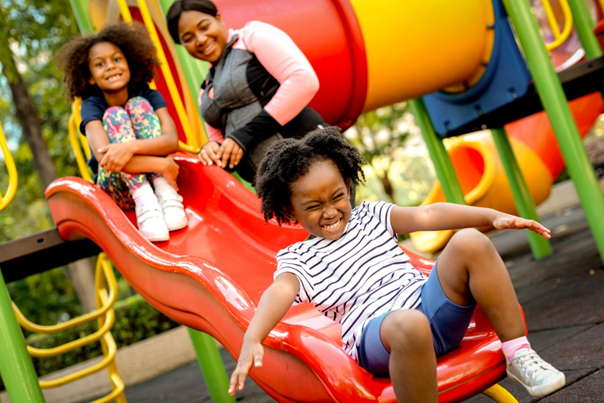
Seen Here: Where play becomes possibility: Juan Visser, Regional Director for Sub-Saharan Africa at Cambridge University Press & Assessment, champions play-based learning as a powerful foundation for lifelong learning—empowering Africa’s youngest minds to explore, discover, build confidence and shape a brighter future. Photo Credit: Supplied
Walk into any preschool classroom and you will quickly discover that learning rarely looks like learning in the traditional sense.
There are giggles, songs, movement, colourful objects, imaginative games, stories, questions — and sometimes a few tears. To an adult observer, it may appear chaotic. But beneath the noise and energy is something much more profound: children building the foundations of how they will think, communicate, collaborate and learn for the rest of their lives.
This is the power of play.
Far from being simply a way for young children to pass the time, play is one of the most powerful mechanisms through which children understand themselves and the world around them. For Africa, where the quality and accessibility of early childhood education remain major challenges, placing play-based learning at the heart of early years education could help unlock enormous potential.
The first years matter most
The earliest years of a child’s life are a period of extraordinary development. The brain is developing rapidly, while children are absorbing language, social cues, behaviours and new ways of understanding the world.
Research, including findings from the OECD’s International Early Learning and Child Well-being Study, has reinforced the importance of providing children with strong foundations during these formative years. What happens before a child enters formal schooling can influence educational attainment, wellbeing and their ability to participate confidently in society later in life.
Yet early childhood education has historically received less attention and investment than formal schooling.
The assumption that “real learning” begins when children enter primary school can have lasting consequences. By the time a child reaches formal schooling, many of the cognitive, emotional, social and communication foundations that underpin successful learning are already developing.
This makes early childhood education not a peripheral component of education systems, but one of their most important building blocks.
Play is serious learning
One of the misconceptions surrounding play-based learning is that play and education are separate activities.
They are not.
When children build with blocks, they are experimenting with balance, shape, space and problem-solving. When they play a counting game, they are developing mathematical understanding. When they listen to a story, they are strengthening vocabulary, comprehension and listening skills.
When children pretend to run a shop, become doctors, teachers or superheroes, they are practising communication, negotiation, empathy and social interaction.
Even seemingly simple games can help develop executive function — the mental processes that enable people to focus, remember instructions, regulate emotions, solve problems and make decisions.
These skills are fundamental to learning.
Play also allows children to learn through active participation. Rather than simply receiving information, they experiment, make mistakes, adapt and try again. In doing so, they develop confidence and resilience.
The lesson is therefore clear: play is not the opposite of learning. For young children, play is one of the most natural and effective pathways into learning.
The teacher remains at the centre
However, effective play-based learning does not mean leaving children entirely to their own devices.
The most successful early years environments combine freedom with purposeful structure. Teachers become facilitators of discovery — observing children, understanding their interests and developmental needs, asking questions, introducing new ideas and knowing when to step back.
A skilled early years teacher can transform an ordinary activity into a powerful learning opportunity.
A story can become a conversation about language and emotions. A drawing activity can develop fine motor skills while encouraging children to express ideas. A game involving numbers can introduce mathematical concepts. Role-play can help children understand relationships, cooperation and empathy.
The teacher’s role is therefore much more than delivering content. It is about creating an environment in which children feel safe enough to explore, curious enough to ask questions and confident enough to make mistakes.
That requires well-trained educators who understand child development and can recognise that children do not all develop at exactly the same pace.
Africa cannot afford to overlook early learning
Across Sub-Saharan Africa, awareness of the importance of early childhood education is growing. Governments, educators and communities increasingly recognise that quality early learning can contribute to stronger educational outcomes and broader social development.
There is also a growing appetite among educators for new approaches.
More than 1,800 educators from Sub-Saharan Africa participated in this year’s Cambridge Early Years Online conference on play-based learning, part of a global event that attracted nearly 10,000 teachers and school leaders.
That level of participation sends a powerful message: educators are looking for practical ideas, evidence-based approaches and opportunities to learn from one another.
But significant challenges remain.
Many early childhood centres operate with limited resources. There are shortages of suitably trained early years educators, uneven infrastructure and significant disparities between urban and rural communities. In some areas, early learning takes place in environments that are unregistered or lack consistent quality standards.
The result is an uneven educational landscape in which a child’s opportunity to receive high-quality early education can depend heavily on where they are born.
From access to quality
Expanding access to early childhood education is essential, but access alone is not enough.
The next challenge is ensuring quality, consistency and relevance.
A strong early years system requires alignment between curriculum, learning resources, assessment, teacher development and the environments in which children learn.
It must also recognise the realities of African communities.
Language matters. Culture matters. Family structures matter. Local knowledge matters.
Global approaches should therefore not simply be transplanted into African classrooms. They should be adapted thoughtfully so that international evidence and best practice can work alongside local languages, cultures and social realities.
This principle is central to the Cambridge Early Years approach, which seeks to create coherence across curriculum, resources, assessment and teacher training while allowing educators to adapt learning to their own settings.
Collaboration is the way forward
The scale of the challenge means no single institution can solve it alone.
Governments have a critical role to play in developing policy, funding early learning and establishing appropriate standards. The private sector can contribute investment, innovation, technology and expertise. Education organisations can support curriculum development and professional learning. Communities and parents remain essential partners in ensuring that children experience continuity between home and school.
Collaboration between these stakeholders can help move early childhood education from being viewed as a social service to being recognised as a strategic investment in national development.
There are valuable lessons to be learned from high-performing education systems around the world — particularly around teacher professionalisation, coherent governance and play-based approaches to early learning.
But Africa also has an opportunity to develop solutions that are uniquely suited to its own circumstances.
Investing in children is investing in Africa
The case for investing in early childhood education ultimately goes far beyond the classroom.
A child who develops confidence in communicating, learns to cooperate with others, becomes comfortable solving problems and develops the resilience to keep trying after failure is gaining more than academic preparation.
They are developing the capabilities needed to participate meaningfully in society.
Africa’s demographic future makes this investment even more significant. The continent’s young population represents an extraordinary opportunity. But demographic potential becomes economic and social potential only when children are equipped with the skills, knowledge and confidence to realise it.
That journey begins much earlier than many people think.
It begins with the first story a child hears.
The first song they sing.
The first number they count.
The first puzzle they solve.
The first time they learn to share.
The first time they fall, try again and discover that they can succeed.
These moments may look like play.
But they are building something much bigger.
They are building the foundations for lifelong learning — and, ultimately, the foundations for Africa’s future.