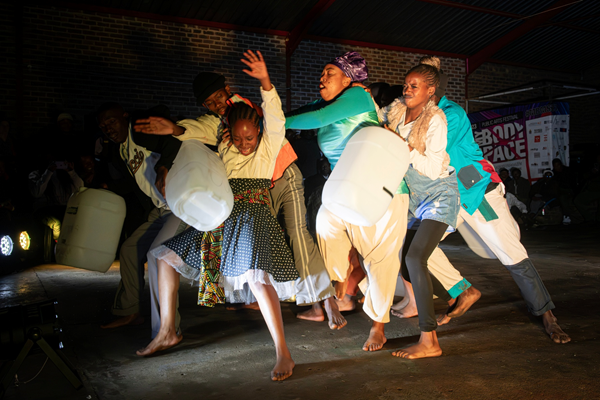
Seen Here: A queue that never ends, a crisis that never pauses — (Co)Ruption turns everyday water scarcity into a gripping reflection of survival, inequality and moral compromise in South Africa. Photo Credit: Supplied
Makhanda, Eastern Cape — At a time when South Africa’s water crisis continues to dominate headlines, a powerful new dance theatre production is using the stage to expose a deeper, more uncomfortable truth: corruption is not only systemic, it is also deeply human.
(Co)Ruption, a bold new work by choreographer Fana Tshabalala, returns to the National Arts Festival (NAF) with a visceral exploration of water scarcity, moral compromise and everyday complicity in systems of corruption. Performed by graduates of the Forgotten Angle Theatre Collaborative (FATC), the production transforms a familiar scene — people queueing for water — into a charged theatrical mirror of society.
A Queue That Reflects a Nation
On stage, the queue is instantly recognisable: a car guard waiting alongside a gogo clutching a cooking pot, a young “slay queen” bargaining for advantage, and others quietly enduring the wait. But the water never comes.
As tensions rise, familiar social behaviours emerge — cutting the line, paying for access, negotiating survival — until the absurdity of the situation exposes something far more unsettling than scarcity alone.
The work draws directly from South Africa’s ongoing infrastructure failures, where water shortages in both rural towns and urban centres have become symbols of deeper governance breakdowns, corruption and unequal access to basic services.
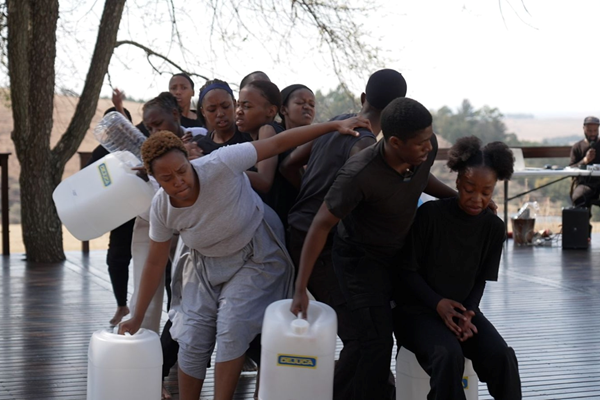
Seen Here: Under the direction of Fana Tshabalala, the stage becomes a mirror of society — where desperation, privilege and power collide in a single waiting line for water that never arrives. Photo Credit: Supplied
Art as a Mirror to Society
For Tshabalala, a former Standard Bank Young Artist for Dance (2013), the work is not simply about protest — it is about reflection.
“I wanted to do something about an issue that affects everyone – water,” he explains. “You cannot survive without it. And yet we see corruption around something so basic, so essential.”
The choreographer interrogates the emergence of so-called “water mafias” — from illegal tank operators to profiteering schemes that exploit scarcity — asking uncomfortable questions about survival, greed and ethical collapse.
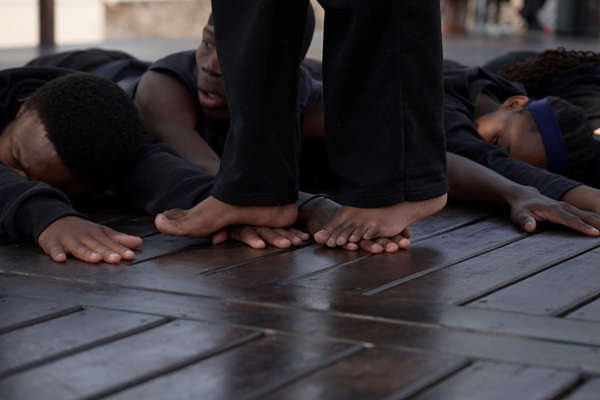
Seen Here: From rural Mpumalanga to the National Arts Festival in Makhanda, the Forgotten Angle Theatre Collaborative brings lived realities to the stage, exposing how corruption quietly shapes daily life in underserved communities. Photo Credit: Supplied
From Rural Mpumalanga to the National Stage
(Co)Ruption was originally developed as part of the Artists Against Corruption initiative, supported by the GIZ Transparency, Integrity & Accountability Programme, and has already been staged in rural Mpumalanga as part of the My Body My Space Festival in Entokozweni (Machadodorp).
That festival, co-created by FATC CEO and former Standard Bank Young Artist PJ Sabbagha (2005), reimagines public space as a site of civic questioning — challenging audiences in small towns to confront issues of infrastructure decay, poverty and governance failure.
The National Arts Festival run marks a significant moment of return for FATC, bringing rural performance voices into one of South Africa’s most prestigious arts platforms.
A Legacy of Artistic Excellence
The production is performed by nine young artists who have emerged from FATC’s youth development pipeline, alongside seasoned performers including Tshabalala and Nicho Aphane.
For Sabbagha, the return to NAF is both symbolic and personal.
“NAF has been a critical career builder for me,” he says. “There is something powerful about returning with young rural artists to a space that shaped our own artistic journeys.”
This year’s production also continues FATC’s long-standing relationship with the festival, which has featured multiple works by Standard Bank Young Artists over the years, including Tracey Human (2001), Sabbagha himself (2005), and Mamela Nyamza (2019), among others.
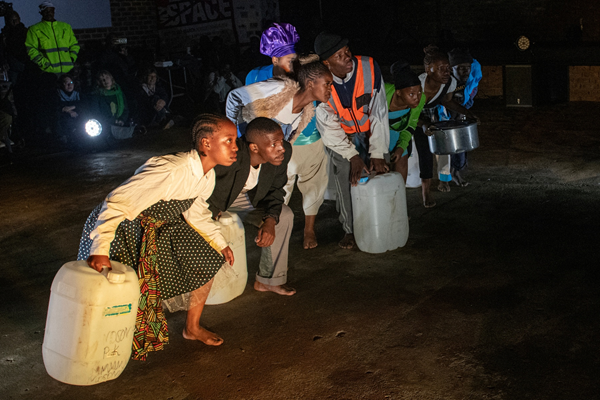
Seen Here: Stripped of dialogue, the physical theatre of (Co)Ruption speaks through movement, tension and sound — revealing the human cost of systems that fail the most basic needs. Photo Credit: Supplied
Physical Theatre Without Words
Stripping away dialogue, (Co)Ruption relies on physical theatre, movement, humour and a live-generated soundscape to communicate its message across language and cultural barriers.
The absence of speech intensifies the universality of the work — corruption, the production suggests, is not spoken; it is lived, enacted and repeated in systems and choices across society.
The Human Cost of Scarcity
Beyond its artistic ambition, the piece is grounded in the harsh realities of rural South Africa, where water insecurity remains a daily struggle.
Small towns continue to face failing infrastructure, limited municipal capacity and economic stagnation — conditions that make the themes of (Co)Ruption feel immediate rather than abstract.
As Tshabalala notes, the production asks whether corruption is imposed from above or quietly sustained by everyday behaviour.
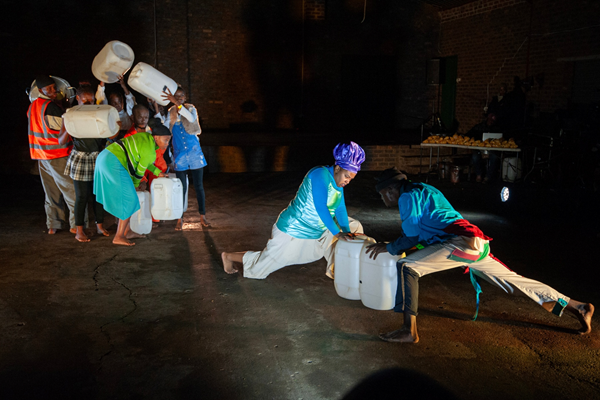
Seen Here: A generational creative return to NAF, as PJ Sabbagha and Nicho Aphane join young FATC graduates in a powerful interrogation of water, power and accountability. Photo Credit: Supplied
Theatre That Refuses Comfort
Provocative, physically intense and emotionally unsettling, (Co)Ruption does not offer easy resolutions. Instead, it invites audiences to confront their own complicity in systems of inequality and survival.
It is theatre designed not only to be watched, but to be questioned — long after the lights go down.
Performance Details
(Co)Ruption runs at the National Arts Festival, Rhodes Theatre:
- 2 July – 18:00
- 3 July – 19:00
- 4 July – 12:00
Tickets: https://tickets.nationalartsfestival.co.za/en/events/1294/coruption
As South Africa continues to grapple with water insecurity and governance challenges, (Co)Ruption arrives as both a creative intervention and a stark reminder: sometimes the most urgent truths are told not in speeches, but in movement.