


By: Lonwabo Mtyeku | Photo Credit: magic828.co.za

Johannesburg — The recent launch of Dr Iqbal Survé’s book, A Shared Future for Humanity, marks a significant intellectual intervention in contemporary debates on global governance, African political economy and ethical leadership. Framed as both a philosophical inquiry and a policy-oriented text, the book advances a compelling argument: that the prevailing global order, defined by asymmetry and fragmentation, can only be stabilised through cooperative, values-driven leadership anchored in human dignity and shared responsibility.
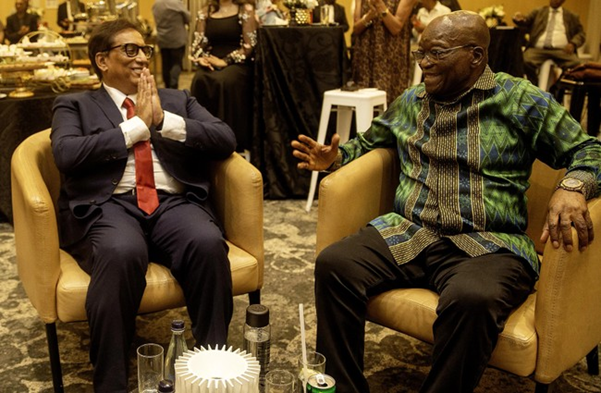
The launch, attended by former President Jacob Zuma and business leader Vivian Reddy, provided a symbolic and substantive backdrop for the book’s core themes, reinforcing its relevance across political, economic and social domains.
Situating the work within global discourse
At its core, A Shared Future for Humanity engages with long-standing academic concerns around multipolarity, sovereignty and development ethics. Dr Survé situates Africa not as a passive recipient of global outcomes, but as an active agent whose historical experiences position it uniquely to advocate for more equitable systems of governance and trade.
Drawing on political history, economic analysis and moral philosophy, the book challenges dominant neoliberal paradigms that prioritise market efficiency over social cohesion. Instead, it advances a model of development that foregrounds inclusivity, institutional integrity and transnational cooperation — themes increasingly echoed in contemporary scholarship on sustainable development and post-globalisation theory.
Leadership, memory and sovereignty
Former President Jacob Zuma, reflecting on the book’s arguments, underscored its emphasis on historical consciousness and national sovereignty. From an academic standpoint, this dimension aligns with postcolonial theory, which stresses the importance of memory and self-determination in shaping future trajectories.
Zuma’s engagement with the text highlighted its critique of global systems that marginalise developing nations through unequal power relations. The book’s insistence on African unity and political agency resonates with Pan-African scholarship that views continental solidarity as a prerequisite for meaningful participation in global decision-making structures.
Business ethics and developmental responsibility
A notable strength of the book lies in its treatment of the private sector as a developmental actor rather than a neutral economic force. Vivian Reddy’s contribution at the launch reinforced this perspective, emphasising the alignment between ethical business practices and long-term economic stability.
From an academic lens, this approach reflects emerging literature on stakeholder capitalism and corporate social responsibility, which argues that sustainable growth depends on the integration of social value creation into business models. Dr Survé’s work contributes to this discourse by positioning ethical leadership as a structural necessity rather than a discretionary ideal.
Africa in a changing world order
The timing of A Shared Future for Humanity is particularly significant. As geopolitical power shifts and multilateral institutions face legitimacy crises, the book calls for renewed global dialogue grounded in mutual respect and shared human interests. It challenges zero-sum conceptions of international relations, proposing instead a cooperative framework that recognises interdependence in addressing issues such as inequality, conflict and climate change.
Academically, this places the work within debates on global public goods and collective action, offering a normative counterpoint to realist and isolationist tendencies currently reshaping international politics.
Conclusion: A contribution beyond the launch
More than a ceremonial publication, A Shared Future for Humanity stands as a substantive contribution to interdisciplinary discourse spanning political science, economics and ethics. Its central proposition — that humanity’s future hinges on collaboration rather than competition — invites rigorous engagement from scholars, policymakers and practitioners alike.
As reflected in the discussions at its launch, the book does not offer simplistic solutions. Instead, it provides a conceptual framework that challenges leaders and institutions to rethink power, responsibility and progress. In doing so, Dr Iqbal Survé positions his work as both a scholarly provocation and a practical call to action in an era defined by uncertainty and profound global interconnection.


